Saturday, December 31, 2011

Wednesday, December 28, 2011
The Strange Triumph of Liberal Democracy
The Strange Triumph of Liberal Democracy: Intelligent observers of Europe in the 1930s thought its future belonged to communism or fascism and would have ridiculed the notion that decades later the entire continent would be democratic. New books by Jan-Werner Müller and Eric Hobsbawm illuminate the changing fortunes of the continent’s great ideologies.
Why Occupy Wall Street is Not the Tea Party of the Left
Why Occupy Wall Street is Not the Tea Party of the Left: Unlike other movements, the rallies across the United States have no distinct constituency, put forward few policy proposals, and have a shifting configuration of supporters. They are something new. These are "we are here" protests.
Tuesday, December 27, 2011
Monday, December 26, 2011
Thursday, December 22, 2011
Wednesday, December 21, 2011
Tuesday, December 20, 2011
Bringing Authoritarianism Back In: Reification, Latent Prejudice, and Economic Threat
Introduction
During the run up to the 2010 mid-term elections in the United States, the NAACP published a controversial report on “Tea Party Nationalism,” documenting what was perceived as racist elements within the emergent conservative grassroots organization.[1] The NAACP’s report became a lightning rod against which supporters and critics of the Tea Party vented their accusations of the other side’s “racism.” Despite the promise of the country’s first black president, Barack Obama, the post-racial era had not yet arrived. Meanwhile, the Southern Poverty Law Center reported a 244 percent jump in right-wing extremist groups and militias from 2008 to 2009.[2] Public fixation on figures such as Glenn Beck who has been called a racist for calling the president a racist, indicate that racial sentiments are on the rise in American public discourse.[3] While many studies have been conducted to determine the scope of the Tea Party and what percentage within the group can be deemed “racist,”[4] an equally interesting question is the fact that a clear definition of racism is yet to be accepted by opposed sides of the argument, perhaps reflecting George Lakoff’s cognitive analysis of politics from the perspective of there being different, incommensurable languages of morality that divide conservative and liberal political opinion.[5]
Perhaps for this reason as well, political sociologists seem to be facing misrecognition of where the clear anger and hostility the Tea Party directs at the government and, in certain instances, other racial groups such as blacks and immigrants, comes from. Whereas much attention is paid to the Tea Party and right-wing reactions to the president’s race and otherness, whether expressed as questions of his birth or religion, not enough attention has been paid to the actual condition of high unemployment, the recession, and the economic insecurity many are facing. At the same time, in efforts to be “objective,” social scientists may avoid calling this behavior what it is – namely, a manifestation of the authoritarian personality theorized by the Frankfurt School critical theorists during the 1930s, 40s, and 50s.
In relation to the issues mentioned above, we argue that the theoretical perspective of authoritarianism, particularly when directed at the sociological, rather than psychological aspects of the phenomena, provides a useful analytic tool that helps us understand the emergence of racialized sentiments that had previously remained latent. Under certain social conditions, especially perceived economic threat, authoritarians’ latent prejudice is far more likely to become activated into confirmed racist attitudes and/or actions. In this sense, authoritarianism exists latently, or, in the words of Adorno and his colleagues, as “prefacism.” We focus on the connection between economic threat and latent prejudice, and our findings indicate that while economic threat does have an influence on manifest racial attitudes, it is partially mediated through an underlying authoritarian personality construct. By conceptualizing this mediating effect in terms of the process of reification we can theorize that authoritarians likely hold a relatively narrow and rigid conception of the world, which may not be conceived of as something that is “socially constructed.” Thus, as threatening information, such as indicators of a poor economy, enter an authoritarian’s worldview the manner through which he or she processes it could be to project that feeling onto an outgroup, for example, an immigrant or minority population.
The relationship between economic threat and authoritarianism is especially relevant in 2011 as we persist within the longest recession since the Great Depression, with the highest unemployment rate since the early 1980s. The ongoing adversities of the 2008 financial crisis clearly represent an economic threat to many Americans, and indications point to a slow recovery in middle and working class employment despite official claims that we are already out of the recession.[6] Our analysis highlights important implications about the future of American political culture and has great significance for understanding the parallel between periods of high unemployment and the emergence of racialized sentiments within the Tea Party.
BACKGROUND
The Authoritarian Personality was published in 1950 by a group of social scientists at the University of California, Berkeley including Theodor W. Adorno.[7] The study was one of five works in a series of publications devoted to examining authoritarianism and conformity in the United States from a critical social-psychology perspective. The study was funded by the American Jewish Committee and examined the relationship between authoritarianism, ethnocentricism and their interaction with external social situations. The study sought to uncover underlying social and psychological factors that were common among survey and interview participants who exhibited anti-Semitic attitudes and prejudices. Following a number of stages of survey and questionnaire development, the Berkeley group identified sentiments such as anti-democratic attitudes, sexual repressiveness, and irrational belief systems, which pointed to a participant’s value on what was termed an “F-Scale.” The F-Scale was said to measure “prefascism” – an underlying, often unconscious worldview and psychological outlook that predisposed oneself to anti-democratic and anti-Semitic attitudes. Theoretically, the psychologist could then determine whether one was inclined toward fascism or racism – an admission that few would actually make publicly – via asking seemingly more innocent or neutral questions, such as one’s feelings concerning the statements: “A person who has bad manners, habits, and breeding can hardly expect to be liked and accepted by decent people,” or “The true American way of life is disappearing so fast that force may be necessary to preserve it.”[8] The project emerged out of an urgent interest on the part of the American Jewish Committee and the US Government to understand the roots of European Fascism and Anti-Fascism which played such large roles in the recently resolved Second World War.
Since its publication, the original Authoritarian Personality project has been the subject of numerous critiques.[9] One author estimates that more than 1,200 publications had addressed the subject by 1987, most of these peaking during the 1970s, during which time 750 articles and books related to the theory were published.[10] Though it would be nearly impossible to read every one of these texts, two themes crop up regularly in many of these sources, which we will argue has distracted attention from the original core theory. These are: an overemphasis on the psychological origins of “where” the authoritarian personality comes from, and an overconcern for whether authoritarianism is a quality that is limited to bearers of right-wing ideological views, or if there is evidence of authoritarianism within adherents of leftist ideology as well. Our goals are two-fold – first we wish to recover the core theory as outlined by the Berkeley group and its theoretical predecessors to indicate its relevance in the present sociopolitical context. Secondly, we wish to direct our study to the social rather than the psychological aspects of the authoritarian personality. Following Howard Gabbenesch,[11] Erich Fromm,[12] Theodor Adorno,[13] and Berger and Pullberg[14] authoritarianism is assumed to be an objective social fact.[15] We will not attempt to confirm, deny, or explain the psychological origins of the authoritarian personality, in terms of family upbringing or cultural values, but will rather direct our research toward uncovering patterns of authoritarianism within US population samples using secondary data analysis focusing on the relationship between latent prejudice, ethnocentrism, and social situation.
The Authoritarian Personality: A Theoretical Model
The original theoretical basis of The Authoritarian Personality had its roots in the research conducted at the so-called “Frankfurt School” in Frankfurt, Germany during the late 1920 and 1930s. The psychologist, Erich Fromm, was particularly instrumental in developing a perspective that tied the depressed social conditions of the Weimar era to the emerging radical right and popular anti-Semitism. Fromm later fleshed out this perspective in his works Escape From Freedom,[16] The Sane Society,[17] and An Anatomy of Human Destructiveness.[18] Understanding and acknowledging the contradiction between modern democratic society and the actualization of human freedom was paramount to early critical social theory. This critical theoretical perspective rooted authoritarian research in an uncompromising recognition of the limits of the Enlightenment project and an acute awareness of the centralization and concentration of the means of mass manipulation.[19] Fromm and the Berkeley Group argued that under certain social conditions, especially economic threat, totalitarianism and fascism can occur—the explanation of which could not be reduced to the crazed actions of isolated individuals. One of the goals of their authoritarian research was to understand the interaction between fascist tendencies and social perceptions within individuals that continued in late capitalist mass democracy.
In Escape from Freedom, Fromm argued that this “crisis of democracy” was a “problem of every modern state”.[20] Likewise, Adorno outlined the sociological condition of the “damaged” individual in a “totally” administered world, confronted by mass culture, disenchantment, and alienation.[21] Explaining the approach to The Authoritarian Personality, Adorno said,
“We followed what I believe to be the plausible idea that in the present society the objective institutions and developmental tendencies have attained such an overwhelming power over individuals that people…are becoming, and evidently in increasing measure, functionaries of the predominant tendencies operating over their heads”.[22]
For the critical theorists, the relationship between consciousness and society was dialectical. One-dimensional conceptualizations of this relationship, for example, in the Enlightment dualisms between mind/body and “Man”/Nature, dominated social science particularly during the postwar era in which positivist and empiricist conceptions of social research were encouraged due to the centralized needs of the military industrial complex.[23] The problem with a one-sided individualistic approach is that it implicitly identifies the cause of fascism in the fallibilities of individuals themselves. In contrast, critical theory eschewed rigid disciplinary boundaries and Adorno’s theoretical perspective was especially ill-suited for compartmentalization. The Authoritarian Personality, reflecting Adorno’s theoretical concerns, did not adhere to the epistemological dichotomies often constructed from a rigid disciplinary boundary between psychology and sociology. The study aimed “to take into account not only the psychological structure of the individual but the total objective situation in which he (sic) lives”.[24]
Figure 1 shows the basic theoretical approach we have drawn from these and other early studies on authoritarianism.[25] The focus is on the interrelationship of three processes: latent prejudice, social situation, and ethnocentrism. The authors of the original study constructed an F-scale used to measure, “the potentially anti-democratic personality” in order to indicate latent prejudice within the individual.[26] The distinction between latent and manifest prejudice was significant because the “threat to democratic societies arises not just from the attitude and behavior of a relatively small minority of declared fascists, but from the syndrome of an unexpressed, potential fascism that comes from the hidden layer of the personality” which can be “traced back to deeper-seated character-structures that predispose people toward authoritarianism”.[27] This can be summarized in the following diagram:
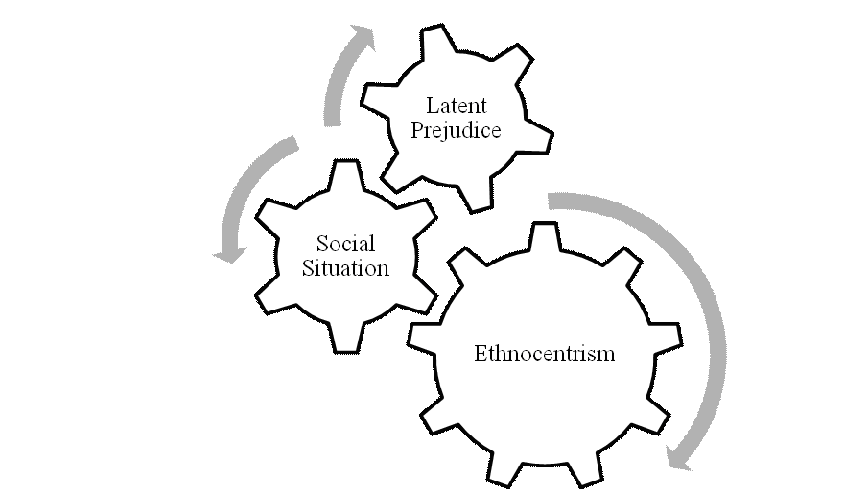 Unlike psychological research into the authoritarian personality, we follow the critical theorists’ notion that these “deep-seated character-structures” are thoroughly social in so far as the fascist potential within individuals cannot be distinguished from the social forms and structures within which this potential remains latent or becomes manifest. The present study adopts this original conceptualization of social situation, referring to the “external stimuli to which Fascist predispositions within the individual have created and continue to react.”[28] Ethnocentrism is defined as the general rejection of outgroups with the simultaneous reification of ingroups.[29] Horkheimer and Adorno had earlier credited this process to the psychological projection of all that one feels insecure about onto the outgroup, for example, as when the Germans projected their own unwanted materialist sentiments and potential for treachery onto the Jewish population.[30]
A major shortcoming of individualistic approaches is the dismissal of the quantity, quality, and interconnectedness of points of analysis.[31] Theoretical explanations of individual alienation, for example, rely on personality disorders defined by professionals. This approach is problematic because, once institutionalized, it assumes a frame of reference that hides the fact that social institutions are human creations. This (mis)understanding has political consequences in instances where individuals are unable to process a social situation, such as economic threat, as being man-made and instead project these threats on to an already reified understanding of the world.[32] Theoretical explanations that do not deal with this contradiction do so at the risk of perpetuating social contradictions that are part and parcel of the very processes of alienation which they seek to explain.[33]
Berger and Pullberg[34] offer useful points of clarification for conceptualizing the relationship between authoritarianism and economic threat in their distinction between objectivation, objectification, alienation, and reification. Objectivation refers to the basic process by which humans transform the external world to meet their needs. Objectification refers to the ways in which people make sense out of transforming the external world. Alienation is the “process by which the unity of the producing and the product is broken”; redefining social reality and consciousness in such a way as to make this process oblique.[35] Reification specifies a certain moment in the process of alienation wherein this redefinition becomes standard objective reality. That is, “reification is objectification in an alienated mode.”[36] Berger and Pullberg stress that objectivation and objectification are “anthropologically necessary” while reification and alienation are not. Conflating objectivation, objectification, reification, and alienation has important implications for or against the notion that authoritarianism is to be found within the individual alone. Fromm’s insights are apt here since if the social situation is defined (by the analyst) in alienated terms, “then those who share this definition will be psychologically healthy.”[37] Failure to distinguish between these four concepts hides a main theoretical assumption this paper seeks to uncover, namely, that social institutions are human in origin and that these social institutions can be perceived by actors as either “natural” (i.e., reified), or as socially constructed.
Any discussion of the authoritarian personality theory must confront the great deal of debate that has surrounded the issue of whether authoritarianism is exclusively the property of a right-wing political perspective or whether it is also evident within adherents of leftist ideology.[38] However, as interesting as this debate is, for our purposes and research question, we feel this issue can be reconciled by reflecting back on the definition of one critic who has challenged the “right-only” authoritarian theories. John Ray suggested that the authoritarian personality model is “nothing but a measure of conservatism, but conservatism of a particularly old-fashioned and tough-minded sort.”[39] Thus, instead of retorting in the vein of other scholars who would insist that “Left-Wing Authoritarianism is a Myth,”[40] we can put the matter behind us by suggesting that we are studying the persistence of this authoritarianism, whether it is old-fashioned, re-fashioned, conservative, or liberal. Our conception of authoritarianism refers to the presence of a particularly-reified worldview, which can then be indicated via latent qualities that are likely related to actual manifest ethnocentrism and racist attitudes.
Indeed, research on authoritarianism has consistently shown a strong positive correlation between authoritarianism and ethnocentrism/racism. In addition, research has supported Fromm’s hypothesis of the link between authoritarianism and economic threat.[41] This relationship between economic threat and authoritarianism is especially relevant in 2011 as we persist within the longest recession since the Great Depression, with the highest unemployment rate since the early 1980s. The ongoing adversities of the 2008 financial crisis clearly represent an economic threat to many Americans, and indications point to a slow recovery in middle and working class employment despite official claims that we are already out of the recession.[42] We therefore take seriously the possibility that many Americans may not be able to process hardships of the economic crisis in relation to the actual sources of these social threats and instead project these threats onto a reified world. The critical theoretical approach of Adorno and others appears to be all the more relevant today.
Recent research on the growth of extreme right-wing movements has failed to pay attention to the important theoretical insights that can be gleaned from The Authoritarian Personality. This is unfortunate given that the growth of these movements has occurred during an ongoing financial crisis that began in 2008 which might be understood in terms of the interplay between socioeconomic structure and authoritarianism. The original theoretical focus within authoritarian personality research (especially those that attended to the interrelationships between latent prejudice, social situation, and ethnocentrism) has the potential to connect the conceptual divide often constructed between the undemocratic actions of seemingly-irrational individual members of society and their objective social world.
DATA AND METHODS
Data for this study are taken from the General Social Survey (GSS). The GSS is a sociological survey used to collect data on attitudes and demographic traits of residents across the United States. GSS data are now collected bi-annually via face to face interviews using standard questionnaires. The survey follows a full probability sample design that covers approximately 97.3% of the residents of the United States.
Dependent Variable: Racism
Drawing on the theoretical perspective of authoritarianism, racism is conceptually defined as the general rejection of outgroups and the simultaneous reification of ingroups. The early critical theorists who developed the theory of authoritarianism had credited this process to the psychological projection of all that one feels insecure about onto the outgroup. Our dependent variable, racism, is based on previous GSS research on racial attitudes, particularly toward blacks, and is operationalized by a standardized scale based on survey questions that indicate racist attitudes (e.g., support for discriminatory laws that would segregate neighborhoods, disfavor for interracial marriage, negative feelings regarding black social improvement, etc.).
Predictor Variables
Based on the original theoretical perspective of authoritarianism, threatening social situations may activate latent prejudice within a population, igniting manifest racism. From this perspective, authoritarianism may act as an essential mediating variable between perceived economic threat and manifest racism. That is, under certain social conditions, especially perceived economic threat, the latent prejudice characteristic of authoritarians is far more likely to become activated into confirmed racist attitudes and/or actions than would otherwise be the case.
Economic Threat
Research on authoritarianism has consistently shown a strong positive relationship between economic threat and racism. Data used for the construction of our first predictor variable come from respondents’ impression of whether the economy has gotten better; stayed the same; or gotten worse. The response that the economy is “getting better” was used as the reference category.
Authoritarianism
Our second predictor variable is constructed by selecting several groups of variables that relatively correspond with the questionnaires used in the original Authoritarian Personality study and then narrowing these groups down to scales that have the highest alpha scores and corresponded well with authoritarianism in previous studies to construct an authoritarian index.
Data Limitations
Use of the GSS or other large secondary survey data to analyze sociological trends in authoritarianism is less common than psychological analyses. This is reflective of the controversy surrounding the psychological origins of authoritarianism, whether in the family, religion, or another psychic source.[43] The primary limitation of the present study is that the variable “economic threat” is only available in the 1994 GSS, which unfortunately limited our analysis to this year. Results should be interpreted by keeping this caveat in mind. Our approach will assume that authoritarianism does exist in some degree in the population and that the theoretical explanation for the correlation between economic threat and ethnocentrism is likely to be mediated through authoritarianism. Our analysis does not in any way “prove” the authoritarian personality theory. Empirical evidence is presented in order to urge social scientists to reconsider the contemporary significance of the original authoritarian personality theory. Our goal is to demonstrate the use-value of the authoritarian personality concept, and the manner in which it can draw our attention to the relationship between latent prejudice, racism, and economic threat.
Method
Our first model is a basic linear (OLS) regression analysis with “racism” as the dependent variable and “authoritarianism” as the independent variable. The second model looks at the relationship between economic threat and ethnocentrism. This is a typical model in many studies of racial attitudes during periods of high unemployment. The variable “economic threat” provides a very direct indicator of respondents’ feelings about the economy, and is thus a better indicator than models used in research that traces a linear relationship between unemployment rates and racism.
The final model incorporates authoritarianism as a predictor in the bi-variate analysis conducted in Model 2. This allows us to test whether economic threat is mediated by an authoritarian personality in predicting respondents’ racial attitudes. Although a more complex analysis is theoretically possible, we justify the use of such parsimonious regression models because we are only interested in the mediating effects of our three variables (racism, economic threat, and authoritarianism). We do not attempt to explain individual racism apart from these predictors.
RESULTS
Table 1 (see Appendix) contains the standardized regression coefficients of authoritarianism and economic threat on racism. Results of Model 1 show a strong correlation between authoritarianism and racism, indicating that an increase in authoritarianism is significantly associated with an increase in racist attitudes. This finding supports the original theories of Adorno and his colleagues, and most subsequent sociological researchers.
Estimates of Model 2 indicate that respondents who thought the economy had “gotten worse” were significantly more likely to exhibit racist attitudes than those who thought the economy had “gotten better.” This finding supports research that indicates that during periods of perceived economic threat, for example, periods of unemployment, racist attitudes increase.
Provided certain data limitations outlined above, Model 3 suggests a striking finding in regard to our theory of authoritarianism and its relationship to perceived economic threat and racist attitudes. When authoritarianism is added as a predictor variable in addition to economic threat, a strong mediating effect is observable in so far as the main effect of economic threat on racism drops from 0.19 (Model 2) to 0.11 (Model 3). Furthermore, results indicate that authoritarianism is a much more significant predictor of racism than feelings of economic threat. Our analysis, therefore, indicates that while economic threat does have an influence on manifest racial attitudes, it is partially mediated through an underlying authoritarian personality construct. In this sense, authoritarianism could exist latently. Then, following an event that can be perceived as economic threat, for example a sense in which the economy is getting worse, this may make the latent prejudice a confirmed racist attitude. By conceptualizing the mediating effect of authoritarianism in terms of the concept of reification we can theorize that those who score high on the authoritarian index likely hold a relatively narrow and rigid conception of the world, which may not be conceived of as something that is “socially constructed.” Thus, as threatening information, such as indicators of a poor economy, enter that respondent’s worldview the manner through which he or she processes it could be to project that feeling onto an outgroup, for example, an immigrant or minority population.
The confirmation of an underlying authoritarian construct as partially mediating the effect of perceived economic threat on expressed racism has great significance for our understanding of racism during periods of unemployment, such as the recession we are presently in. Unfortunately, the GSS data, which deals with relatively general questions, and not specifically related to authoritarian personality questions, are not able to provide us with the necessary variables to track, for example, the sub-scale of “traditional familialism” used in the authoritarian index past 1998, or the very important variable of “economic threat” other than in year 1994.[44] However, this initial test of the theory of authoritarianism indicates that a more substantial survey expressly dedicated to determining Americans’ authoritarian personality constructs would prove to be of great interest in 2011 as the recession, high unemployment, and racialized discourse surrounding the Tea Party and other groups persist.
CONCLUSION
In this paper we argued that recent research on the growth of extreme right-wing movements has failed to pay attention to the important theoretical insights that can be gleaned from The Authoritarian Personality. Although our data analysis cannot confirm or deny the relationship between authoritarianism and racism and the growth of the Tea Party, it is clear that the original theoretical orientation of The Authoritarian Personality provides a useful analytic tool that helps us understand the emergence of racialized sentiments that had previously remained latent and is thus worthy of reconsideration. Our regression analyses support the original authoritarian personality theory, indicating a strong correlation between authoritarianism and racism. Results also indicate that while economic threat does have an influence on manifest racial attitudes, it is partially mediated by an underlying authoritarian personality construct. We explained alienation and reification as two key concepts in this process, pointing to a rigid, narrowly defined worldview that leads to the projection of social threats onto outgroups. We did not concern ourselves with whether or not authoritarianism is exclusively the property of the political right or left because like Adorno and his colleagues, we were interested in studying the persistence of authoritarianism qua authoritarianism, whatever its manifest form. Having conceived of authoritarianism as an objective social fact, we directed our attention to social conditions, specifically economic threat, that activate latent prejudice.
Our analysis also highlights important issues surrounding the future of American political culture. The recognition of the social fact of authoritarian personalities changes the landscape of the sociopolitical phenomena we seek to address. By definition, authoritarianism is “reactionary”—policy or social opinions are not “driving” attitudes so to speak, these opinions are manifestations of certain ways of seeing the world. This has implications for both progressive hopes for a “double-movement” as well as political sociological research which needs to recognize that not all members of the polity are operating with the same worldviews, or with the same capacity to conceive of competing worldviews. However, perhaps because of a break between theory and practice, it appears academics and progressives may not be paying adequate attention to the original concept of authoritarianism developed by the Frankfurt School critical theorists during the 1930s, 40s, and 50s. Progressives may regularly throw around the term fascist without breaking down analytically what they mean[45] while academics have taken the original theory of authoritarianism and reduced it into an uninteresting, unusable framework in efforts to be objective.[46]
This is all the more relevant when one considers the original inspiration of the Frankfurt School theorists. These scholars were interested in understanding the ways in which the working class in Germany shifted to the political right instead of the left, as traditional Marxists would have expected. The authoritarian personality model provides an explanation for why this may occur. To be sure, and as certain scholars point out,[47] limits to democratic politics result from systematically grounded exploitation and inequality. Overcoming these would involve overcoming the conditions of modern society that predetermine social action.[48] Because of the implications of the authoritarian personality, different models of political analysis and activism may need to be conceived. This is one of the “hard truths” we can glean from The Authoritarian Personality, and potentially one of the reasons it has been neglected. Dealing with the social fact of authoritarianism problematizes the entire progressive political agenda. That is, the solutions to a problem of reified worldviews are, in fact, much more difficult than reconfiguring the relations of production, and are in fact a necessary precondition for the latter potentially to emerge. What the strategies and possibilities for this type of action might be cannot be directly predetermined by the research at hand, but certainly the spheres of education, media, and political discourse need to be considered in the light of this project.
During the run up to the 2010 mid-term elections in the United States, the NAACP published a controversial report on “Tea Party Nationalism,” documenting what was perceived as racist elements within the emergent conservative grassroots organization.[1] The NAACP’s report became a lightning rod against which supporters and critics of the Tea Party vented their accusations of the other side’s “racism.” Despite the promise of the country’s first black president, Barack Obama, the post-racial era had not yet arrived. Meanwhile, the Southern Poverty Law Center reported a 244 percent jump in right-wing extremist groups and militias from 2008 to 2009.[2] Public fixation on figures such as Glenn Beck who has been called a racist for calling the president a racist, indicate that racial sentiments are on the rise in American public discourse.[3] While many studies have been conducted to determine the scope of the Tea Party and what percentage within the group can be deemed “racist,”[4] an equally interesting question is the fact that a clear definition of racism is yet to be accepted by opposed sides of the argument, perhaps reflecting George Lakoff’s cognitive analysis of politics from the perspective of there being different, incommensurable languages of morality that divide conservative and liberal political opinion.[5]
Perhaps for this reason as well, political sociologists seem to be facing misrecognition of where the clear anger and hostility the Tea Party directs at the government and, in certain instances, other racial groups such as blacks and immigrants, comes from. Whereas much attention is paid to the Tea Party and right-wing reactions to the president’s race and otherness, whether expressed as questions of his birth or religion, not enough attention has been paid to the actual condition of high unemployment, the recession, and the economic insecurity many are facing. At the same time, in efforts to be “objective,” social scientists may avoid calling this behavior what it is – namely, a manifestation of the authoritarian personality theorized by the Frankfurt School critical theorists during the 1930s, 40s, and 50s.
In relation to the issues mentioned above, we argue that the theoretical perspective of authoritarianism, particularly when directed at the sociological, rather than psychological aspects of the phenomena, provides a useful analytic tool that helps us understand the emergence of racialized sentiments that had previously remained latent. Under certain social conditions, especially perceived economic threat, authoritarians’ latent prejudice is far more likely to become activated into confirmed racist attitudes and/or actions. In this sense, authoritarianism exists latently, or, in the words of Adorno and his colleagues, as “prefacism.” We focus on the connection between economic threat and latent prejudice, and our findings indicate that while economic threat does have an influence on manifest racial attitudes, it is partially mediated through an underlying authoritarian personality construct. By conceptualizing this mediating effect in terms of the process of reification we can theorize that authoritarians likely hold a relatively narrow and rigid conception of the world, which may not be conceived of as something that is “socially constructed.” Thus, as threatening information, such as indicators of a poor economy, enter an authoritarian’s worldview the manner through which he or she processes it could be to project that feeling onto an outgroup, for example, an immigrant or minority population.
The relationship between economic threat and authoritarianism is especially relevant in 2011 as we persist within the longest recession since the Great Depression, with the highest unemployment rate since the early 1980s. The ongoing adversities of the 2008 financial crisis clearly represent an economic threat to many Americans, and indications point to a slow recovery in middle and working class employment despite official claims that we are already out of the recession.[6] Our analysis highlights important implications about the future of American political culture and has great significance for understanding the parallel between periods of high unemployment and the emergence of racialized sentiments within the Tea Party.
BACKGROUND
The Authoritarian Personality was published in 1950 by a group of social scientists at the University of California, Berkeley including Theodor W. Adorno.[7] The study was one of five works in a series of publications devoted to examining authoritarianism and conformity in the United States from a critical social-psychology perspective. The study was funded by the American Jewish Committee and examined the relationship between authoritarianism, ethnocentricism and their interaction with external social situations. The study sought to uncover underlying social and psychological factors that were common among survey and interview participants who exhibited anti-Semitic attitudes and prejudices. Following a number of stages of survey and questionnaire development, the Berkeley group identified sentiments such as anti-democratic attitudes, sexual repressiveness, and irrational belief systems, which pointed to a participant’s value on what was termed an “F-Scale.” The F-Scale was said to measure “prefascism” – an underlying, often unconscious worldview and psychological outlook that predisposed oneself to anti-democratic and anti-Semitic attitudes. Theoretically, the psychologist could then determine whether one was inclined toward fascism or racism – an admission that few would actually make publicly – via asking seemingly more innocent or neutral questions, such as one’s feelings concerning the statements: “A person who has bad manners, habits, and breeding can hardly expect to be liked and accepted by decent people,” or “The true American way of life is disappearing so fast that force may be necessary to preserve it.”[8] The project emerged out of an urgent interest on the part of the American Jewish Committee and the US Government to understand the roots of European Fascism and Anti-Fascism which played such large roles in the recently resolved Second World War.
Since its publication, the original Authoritarian Personality project has been the subject of numerous critiques.[9] One author estimates that more than 1,200 publications had addressed the subject by 1987, most of these peaking during the 1970s, during which time 750 articles and books related to the theory were published.[10] Though it would be nearly impossible to read every one of these texts, two themes crop up regularly in many of these sources, which we will argue has distracted attention from the original core theory. These are: an overemphasis on the psychological origins of “where” the authoritarian personality comes from, and an overconcern for whether authoritarianism is a quality that is limited to bearers of right-wing ideological views, or if there is evidence of authoritarianism within adherents of leftist ideology as well. Our goals are two-fold – first we wish to recover the core theory as outlined by the Berkeley group and its theoretical predecessors to indicate its relevance in the present sociopolitical context. Secondly, we wish to direct our study to the social rather than the psychological aspects of the authoritarian personality. Following Howard Gabbenesch,[11] Erich Fromm,[12] Theodor Adorno,[13] and Berger and Pullberg[14] authoritarianism is assumed to be an objective social fact.[15] We will not attempt to confirm, deny, or explain the psychological origins of the authoritarian personality, in terms of family upbringing or cultural values, but will rather direct our research toward uncovering patterns of authoritarianism within US population samples using secondary data analysis focusing on the relationship between latent prejudice, ethnocentrism, and social situation.
The Authoritarian Personality: A Theoretical Model
The original theoretical basis of The Authoritarian Personality had its roots in the research conducted at the so-called “Frankfurt School” in Frankfurt, Germany during the late 1920 and 1930s. The psychologist, Erich Fromm, was particularly instrumental in developing a perspective that tied the depressed social conditions of the Weimar era to the emerging radical right and popular anti-Semitism. Fromm later fleshed out this perspective in his works Escape From Freedom,[16] The Sane Society,[17] and An Anatomy of Human Destructiveness.[18] Understanding and acknowledging the contradiction between modern democratic society and the actualization of human freedom was paramount to early critical social theory. This critical theoretical perspective rooted authoritarian research in an uncompromising recognition of the limits of the Enlightenment project and an acute awareness of the centralization and concentration of the means of mass manipulation.[19] Fromm and the Berkeley Group argued that under certain social conditions, especially economic threat, totalitarianism and fascism can occur—the explanation of which could not be reduced to the crazed actions of isolated individuals. One of the goals of their authoritarian research was to understand the interaction between fascist tendencies and social perceptions within individuals that continued in late capitalist mass democracy.
In Escape from Freedom, Fromm argued that this “crisis of democracy” was a “problem of every modern state”.[20] Likewise, Adorno outlined the sociological condition of the “damaged” individual in a “totally” administered world, confronted by mass culture, disenchantment, and alienation.[21] Explaining the approach to The Authoritarian Personality, Adorno said,
“We followed what I believe to be the plausible idea that in the present society the objective institutions and developmental tendencies have attained such an overwhelming power over individuals that people…are becoming, and evidently in increasing measure, functionaries of the predominant tendencies operating over their heads”.[22]
For the critical theorists, the relationship between consciousness and society was dialectical. One-dimensional conceptualizations of this relationship, for example, in the Enlightment dualisms between mind/body and “Man”/Nature, dominated social science particularly during the postwar era in which positivist and empiricist conceptions of social research were encouraged due to the centralized needs of the military industrial complex.[23] The problem with a one-sided individualistic approach is that it implicitly identifies the cause of fascism in the fallibilities of individuals themselves. In contrast, critical theory eschewed rigid disciplinary boundaries and Adorno’s theoretical perspective was especially ill-suited for compartmentalization. The Authoritarian Personality, reflecting Adorno’s theoretical concerns, did not adhere to the epistemological dichotomies often constructed from a rigid disciplinary boundary between psychology and sociology. The study aimed “to take into account not only the psychological structure of the individual but the total objective situation in which he (sic) lives”.[24]
Figure 1 shows the basic theoretical approach we have drawn from these and other early studies on authoritarianism.[25] The focus is on the interrelationship of three processes: latent prejudice, social situation, and ethnocentrism. The authors of the original study constructed an F-scale used to measure, “the potentially anti-democratic personality” in order to indicate latent prejudice within the individual.[26] The distinction between latent and manifest prejudice was significant because the “threat to democratic societies arises not just from the attitude and behavior of a relatively small minority of declared fascists, but from the syndrome of an unexpressed, potential fascism that comes from the hidden layer of the personality” which can be “traced back to deeper-seated character-structures that predispose people toward authoritarianism”.[27] This can be summarized in the following diagram:
A major shortcoming of individualistic approaches is the dismissal of the quantity, quality, and interconnectedness of points of analysis.[31] Theoretical explanations of individual alienation, for example, rely on personality disorders defined by professionals. This approach is problematic because, once institutionalized, it assumes a frame of reference that hides the fact that social institutions are human creations. This (mis)understanding has political consequences in instances where individuals are unable to process a social situation, such as economic threat, as being man-made and instead project these threats on to an already reified understanding of the world.[32] Theoretical explanations that do not deal with this contradiction do so at the risk of perpetuating social contradictions that are part and parcel of the very processes of alienation which they seek to explain.[33]
Berger and Pullberg[34] offer useful points of clarification for conceptualizing the relationship between authoritarianism and economic threat in their distinction between objectivation, objectification, alienation, and reification. Objectivation refers to the basic process by which humans transform the external world to meet their needs. Objectification refers to the ways in which people make sense out of transforming the external world. Alienation is the “process by which the unity of the producing and the product is broken”; redefining social reality and consciousness in such a way as to make this process oblique.[35] Reification specifies a certain moment in the process of alienation wherein this redefinition becomes standard objective reality. That is, “reification is objectification in an alienated mode.”[36] Berger and Pullberg stress that objectivation and objectification are “anthropologically necessary” while reification and alienation are not. Conflating objectivation, objectification, reification, and alienation has important implications for or against the notion that authoritarianism is to be found within the individual alone. Fromm’s insights are apt here since if the social situation is defined (by the analyst) in alienated terms, “then those who share this definition will be psychologically healthy.”[37] Failure to distinguish between these four concepts hides a main theoretical assumption this paper seeks to uncover, namely, that social institutions are human in origin and that these social institutions can be perceived by actors as either “natural” (i.e., reified), or as socially constructed.
Any discussion of the authoritarian personality theory must confront the great deal of debate that has surrounded the issue of whether authoritarianism is exclusively the property of a right-wing political perspective or whether it is also evident within adherents of leftist ideology.[38] However, as interesting as this debate is, for our purposes and research question, we feel this issue can be reconciled by reflecting back on the definition of one critic who has challenged the “right-only” authoritarian theories. John Ray suggested that the authoritarian personality model is “nothing but a measure of conservatism, but conservatism of a particularly old-fashioned and tough-minded sort.”[39] Thus, instead of retorting in the vein of other scholars who would insist that “Left-Wing Authoritarianism is a Myth,”[40] we can put the matter behind us by suggesting that we are studying the persistence of this authoritarianism, whether it is old-fashioned, re-fashioned, conservative, or liberal. Our conception of authoritarianism refers to the presence of a particularly-reified worldview, which can then be indicated via latent qualities that are likely related to actual manifest ethnocentrism and racist attitudes.
Indeed, research on authoritarianism has consistently shown a strong positive correlation between authoritarianism and ethnocentrism/racism. In addition, research has supported Fromm’s hypothesis of the link between authoritarianism and economic threat.[41] This relationship between economic threat and authoritarianism is especially relevant in 2011 as we persist within the longest recession since the Great Depression, with the highest unemployment rate since the early 1980s. The ongoing adversities of the 2008 financial crisis clearly represent an economic threat to many Americans, and indications point to a slow recovery in middle and working class employment despite official claims that we are already out of the recession.[42] We therefore take seriously the possibility that many Americans may not be able to process hardships of the economic crisis in relation to the actual sources of these social threats and instead project these threats onto a reified world. The critical theoretical approach of Adorno and others appears to be all the more relevant today.
Recent research on the growth of extreme right-wing movements has failed to pay attention to the important theoretical insights that can be gleaned from The Authoritarian Personality. This is unfortunate given that the growth of these movements has occurred during an ongoing financial crisis that began in 2008 which might be understood in terms of the interplay between socioeconomic structure and authoritarianism. The original theoretical focus within authoritarian personality research (especially those that attended to the interrelationships between latent prejudice, social situation, and ethnocentrism) has the potential to connect the conceptual divide often constructed between the undemocratic actions of seemingly-irrational individual members of society and their objective social world.
DATA AND METHODS
Data for this study are taken from the General Social Survey (GSS). The GSS is a sociological survey used to collect data on attitudes and demographic traits of residents across the United States. GSS data are now collected bi-annually via face to face interviews using standard questionnaires. The survey follows a full probability sample design that covers approximately 97.3% of the residents of the United States.
Dependent Variable: Racism
Drawing on the theoretical perspective of authoritarianism, racism is conceptually defined as the general rejection of outgroups and the simultaneous reification of ingroups. The early critical theorists who developed the theory of authoritarianism had credited this process to the psychological projection of all that one feels insecure about onto the outgroup. Our dependent variable, racism, is based on previous GSS research on racial attitudes, particularly toward blacks, and is operationalized by a standardized scale based on survey questions that indicate racist attitudes (e.g., support for discriminatory laws that would segregate neighborhoods, disfavor for interracial marriage, negative feelings regarding black social improvement, etc.).
Predictor Variables
Based on the original theoretical perspective of authoritarianism, threatening social situations may activate latent prejudice within a population, igniting manifest racism. From this perspective, authoritarianism may act as an essential mediating variable between perceived economic threat and manifest racism. That is, under certain social conditions, especially perceived economic threat, the latent prejudice characteristic of authoritarians is far more likely to become activated into confirmed racist attitudes and/or actions than would otherwise be the case.
Economic Threat
Research on authoritarianism has consistently shown a strong positive relationship between economic threat and racism. Data used for the construction of our first predictor variable come from respondents’ impression of whether the economy has gotten better; stayed the same; or gotten worse. The response that the economy is “getting better” was used as the reference category.
Authoritarianism
Our second predictor variable is constructed by selecting several groups of variables that relatively correspond with the questionnaires used in the original Authoritarian Personality study and then narrowing these groups down to scales that have the highest alpha scores and corresponded well with authoritarianism in previous studies to construct an authoritarian index.
Data Limitations
Use of the GSS or other large secondary survey data to analyze sociological trends in authoritarianism is less common than psychological analyses. This is reflective of the controversy surrounding the psychological origins of authoritarianism, whether in the family, religion, or another psychic source.[43] The primary limitation of the present study is that the variable “economic threat” is only available in the 1994 GSS, which unfortunately limited our analysis to this year. Results should be interpreted by keeping this caveat in mind. Our approach will assume that authoritarianism does exist in some degree in the population and that the theoretical explanation for the correlation between economic threat and ethnocentrism is likely to be mediated through authoritarianism. Our analysis does not in any way “prove” the authoritarian personality theory. Empirical evidence is presented in order to urge social scientists to reconsider the contemporary significance of the original authoritarian personality theory. Our goal is to demonstrate the use-value of the authoritarian personality concept, and the manner in which it can draw our attention to the relationship between latent prejudice, racism, and economic threat.
Method
Our first model is a basic linear (OLS) regression analysis with “racism” as the dependent variable and “authoritarianism” as the independent variable. The second model looks at the relationship between economic threat and ethnocentrism. This is a typical model in many studies of racial attitudes during periods of high unemployment. The variable “economic threat” provides a very direct indicator of respondents’ feelings about the economy, and is thus a better indicator than models used in research that traces a linear relationship between unemployment rates and racism.
The final model incorporates authoritarianism as a predictor in the bi-variate analysis conducted in Model 2. This allows us to test whether economic threat is mediated by an authoritarian personality in predicting respondents’ racial attitudes. Although a more complex analysis is theoretically possible, we justify the use of such parsimonious regression models because we are only interested in the mediating effects of our three variables (racism, economic threat, and authoritarianism). We do not attempt to explain individual racism apart from these predictors.
RESULTS
Table 1 (see Appendix) contains the standardized regression coefficients of authoritarianism and economic threat on racism. Results of Model 1 show a strong correlation between authoritarianism and racism, indicating that an increase in authoritarianism is significantly associated with an increase in racist attitudes. This finding supports the original theories of Adorno and his colleagues, and most subsequent sociological researchers.
Estimates of Model 2 indicate that respondents who thought the economy had “gotten worse” were significantly more likely to exhibit racist attitudes than those who thought the economy had “gotten better.” This finding supports research that indicates that during periods of perceived economic threat, for example, periods of unemployment, racist attitudes increase.
Provided certain data limitations outlined above, Model 3 suggests a striking finding in regard to our theory of authoritarianism and its relationship to perceived economic threat and racist attitudes. When authoritarianism is added as a predictor variable in addition to economic threat, a strong mediating effect is observable in so far as the main effect of economic threat on racism drops from 0.19 (Model 2) to 0.11 (Model 3). Furthermore, results indicate that authoritarianism is a much more significant predictor of racism than feelings of economic threat. Our analysis, therefore, indicates that while economic threat does have an influence on manifest racial attitudes, it is partially mediated through an underlying authoritarian personality construct. In this sense, authoritarianism could exist latently. Then, following an event that can be perceived as economic threat, for example a sense in which the economy is getting worse, this may make the latent prejudice a confirmed racist attitude. By conceptualizing the mediating effect of authoritarianism in terms of the concept of reification we can theorize that those who score high on the authoritarian index likely hold a relatively narrow and rigid conception of the world, which may not be conceived of as something that is “socially constructed.” Thus, as threatening information, such as indicators of a poor economy, enter that respondent’s worldview the manner through which he or she processes it could be to project that feeling onto an outgroup, for example, an immigrant or minority population.
The confirmation of an underlying authoritarian construct as partially mediating the effect of perceived economic threat on expressed racism has great significance for our understanding of racism during periods of unemployment, such as the recession we are presently in. Unfortunately, the GSS data, which deals with relatively general questions, and not specifically related to authoritarian personality questions, are not able to provide us with the necessary variables to track, for example, the sub-scale of “traditional familialism” used in the authoritarian index past 1998, or the very important variable of “economic threat” other than in year 1994.[44] However, this initial test of the theory of authoritarianism indicates that a more substantial survey expressly dedicated to determining Americans’ authoritarian personality constructs would prove to be of great interest in 2011 as the recession, high unemployment, and racialized discourse surrounding the Tea Party and other groups persist.
CONCLUSION
In this paper we argued that recent research on the growth of extreme right-wing movements has failed to pay attention to the important theoretical insights that can be gleaned from The Authoritarian Personality. Although our data analysis cannot confirm or deny the relationship between authoritarianism and racism and the growth of the Tea Party, it is clear that the original theoretical orientation of The Authoritarian Personality provides a useful analytic tool that helps us understand the emergence of racialized sentiments that had previously remained latent and is thus worthy of reconsideration. Our regression analyses support the original authoritarian personality theory, indicating a strong correlation between authoritarianism and racism. Results also indicate that while economic threat does have an influence on manifest racial attitudes, it is partially mediated by an underlying authoritarian personality construct. We explained alienation and reification as two key concepts in this process, pointing to a rigid, narrowly defined worldview that leads to the projection of social threats onto outgroups. We did not concern ourselves with whether or not authoritarianism is exclusively the property of the political right or left because like Adorno and his colleagues, we were interested in studying the persistence of authoritarianism qua authoritarianism, whatever its manifest form. Having conceived of authoritarianism as an objective social fact, we directed our attention to social conditions, specifically economic threat, that activate latent prejudice.
Our analysis also highlights important issues surrounding the future of American political culture. The recognition of the social fact of authoritarian personalities changes the landscape of the sociopolitical phenomena we seek to address. By definition, authoritarianism is “reactionary”—policy or social opinions are not “driving” attitudes so to speak, these opinions are manifestations of certain ways of seeing the world. This has implications for both progressive hopes for a “double-movement” as well as political sociological research which needs to recognize that not all members of the polity are operating with the same worldviews, or with the same capacity to conceive of competing worldviews. However, perhaps because of a break between theory and practice, it appears academics and progressives may not be paying adequate attention to the original concept of authoritarianism developed by the Frankfurt School critical theorists during the 1930s, 40s, and 50s. Progressives may regularly throw around the term fascist without breaking down analytically what they mean[45] while academics have taken the original theory of authoritarianism and reduced it into an uninteresting, unusable framework in efforts to be objective.[46]
This is all the more relevant when one considers the original inspiration of the Frankfurt School theorists. These scholars were interested in understanding the ways in which the working class in Germany shifted to the political right instead of the left, as traditional Marxists would have expected. The authoritarian personality model provides an explanation for why this may occur. To be sure, and as certain scholars point out,[47] limits to democratic politics result from systematically grounded exploitation and inequality. Overcoming these would involve overcoming the conditions of modern society that predetermine social action.[48] Because of the implications of the authoritarian personality, different models of political analysis and activism may need to be conceived. This is one of the “hard truths” we can glean from The Authoritarian Personality, and potentially one of the reasons it has been neglected. Dealing with the social fact of authoritarianism problematizes the entire progressive political agenda. That is, the solutions to a problem of reified worldviews are, in fact, much more difficult than reconfiguring the relations of production, and are in fact a necessary precondition for the latter potentially to emerge. What the strategies and possibilities for this type of action might be cannot be directly predetermined by the research at hand, but certainly the spheres of education, media, and political discourse need to be considered in the light of this project.
Appendix
Table 1. Standardized Regression Coefficients of Authoritarianism on Racism| Model 1 | Model 2 | Model 3 | |||
| Racism | Racism | Racism | |||
| Authoritarianism | 0.41*** | Economic Threat | 0.19*** | Economic Threat | 0.11* |
| Authoritarianism | 0.42*** | ||||
Notes
[1] Devin Burghart et al., Tea Party Nationalism, 20 Oct. 2010, 10 Nov. 2010 http://www.teapartynationalism.com/the-reportbriall-of-tea-party-nationalismi; although many Tea Party supporters, including black conservatives, deny accusations of the organization’s “racism,” the report claims to have established links between Tea Party organizations and various hate groups, including white supremacist and anti-immigration groups.
[2] Mark Potok, “Rage on the Right: The Year in Hate and Extremism” (Montgomery, AL: Southern Poverty Law Center, 2010).
[3] Sean Wilentz, “Confounding Fathers: The Tea Party’s Cold War Roots,” The New Yorker, 18 Oct. 2010.
[4] Amy Gardner, “Gaguing the Scope of the Tea Party Movement in America,” The Washington Post, 24 Oct. 2010; Kate Zernike, Boiling Mad : Inside Tea Party America (New York, NY: Times Books/Henry Holt and Co., 2010).
[5] George Lakoff, Moral politics : How Liberals and Conservatives Think (Chicago, IL: University of Chicago Press, 2002).
[6] U.S. Department of Labor, Bureau of Labor Statistics Economic News Release: Employment Situation Summary, 3 June 2011 http://www.bls.gov/news.release/empsit.nr0.htm.
[7] Theodore W. Adorno, et al., The Authoritarian Personality (New York, NY: Harper & Row, 1950).
[8] Adorno et al. 1950, 178.
[9] R. Christie and M. Jahoda, eds. Studies in the Scope and Method of “The Authoritarian Personality,” (New York, NY: The Free Press, 1954); John Ray, “Why the F-Scale Predicts Racism: A Critical Review,” Political Psychology 9 (December 1988): 671-679; John Levi Martin, “The Authoritarian Personality, 50 Years Later: What Questions are there for Political Psychology?” Political Psychology 22 (March 2001): 1-26.
[10] Marinus H. van Ijzendoorn, “Moral Judgement, Authoritarianism and Ethnocentrism,” Journal of Social Psychology 129 (December 1989: 37-45).
[11] Howard Gabbennesch, “Authoritarianism as Worldview,” American Journal of Sociology 77 (March 1972): 857-875.
[12] Erich Fromm, Escape From Freedom (New York, NY [etc.]: Farrar & Rinehart, 1941).
[13] Adorno et al. 1950
[14] Peter Berger and Stanley Pullberg, “Reification and the Sociological Critique of Consciousness,” History and Theory 4 (1964-65): 196-211.
[15] Emile Durkheim, The Rules of the Sociological Method, trans. S. A. Solovay and J. Mueller (Chicago, IL: University of Chicago Press, 1938).
[16] Fromm 1941.
[17] Erich Fromm, The Sane Society (New York, NY: Rinehart, 1955).
[18] Erich Fromm, The Anatomy of Human Destructiveness (New York, NY: Holt, 1973).
[19] Max Horkheimer and Theodor W. Adorno, and Gunzelin Schmid Noerr, Dialectic of Enlightenment: Philosophical Fragments (Stanford, California: Stanford University Press, 2002); Herbert Marcuse, One-dimensional Man: Studies in the Ideology of Advanced Industrial Society (Boston, MA: Beacon Press, 1991); Theodor W. Adorno, Negative Dialectics (New York, NY: Seabury Press, 1973).
[20] Fromm 1941, 20.
[21] Theodor W. Adorno, Minima Moralia: Reflections on a Damaged Life, trans. E.F.N. Jephcott (New York, NY: Verso, 2005).
[22] Theodor W. Adorno, quoted in Stefan Müller-Doohm, Adorno: A Biography, trans. R. Livingstone (Cambridge, MA: Polity Press, 2005).
[23] George Steinmetz, ed., The Politics of Method in the Human Sciences: Positivism and its Epistemological Others (Durham, NC: Duke University Press, 2005).
[24] Adorno et al. 1950, 8.
[25] See also Seymour Martin Lipset, “Democracy and Working-Class Authoritarianism,” American Sociological Review 24 (August 1959): 482-501.
[26] Adorno et al. 1950.
[27] Müller-Doohm 2005, 294.
[28] Adorno et al. 1950, vii.
[29] See Christie 1954, 153.
[30] Horkeimer and Adorno 2002; see also Moishe Postone, “Anti-Semitism and National Socialism: Notes on the German Reaction to ‘Holocaust’,” New German Critique 19 (Winter 1980): 97-115; Hannah Arendt, The Origins of Totalitarianism (New York, NY: Schocken Books, 2004).
[31] See Bruno Latour, Reassembling the Social: An Introduction to Actor-Network-Theory (New York, NY: Oxford University Press-USA, 2008).
[32] Berger and Pullberg 1965.
[33] Harry F. Dahms, “How Social Science is Impossible Without Critical Theory: The Immersion of Mainstream Approaches in Time and Space” in No Social Science Without Critical Theory (Current Perspectives in Social Theory) 26 (June 2008): 3-61; Peter Berger and Thomas Luckmann, The Social Construction of Reality: A Treatise in the Sociology of Knowledge (New York, NY: Anchor Books, 1967); Fromm 1941.
[34] Berger and Pullberg 1965.
[35] ibid., 61.
[36] ibid., 61.
[37] ibid., 61.
[38] Richard Christie and John Garcia, “Subcultural Variation in Authoritarian Personality,” The Journal of Abnormal and Social Psychology 46 (October 1951): 457-468; Seymour Martin Lipset, Political Man: The Social Bases of Politics (Garden City, NY: Doubleday, 1960); Bob Altemeyer, Enemies of Freedom: Understanding Right-Wing Authoritarianism (San Francisco, CA: Jossey-Bass, 1988); John Ray, “Half of All Authoritarians are Left Wing: A Reply to Eysench and Stone,” Political Psychology 19 (March 1983): 707-720; Ray 1988.
[39] Ray 1983, 141.
[40] William Stone, “The Myth of Left-Wing Authoritarianism,” Political Psychology 2 (Autumn-Winter 1980): 3-19.
[41] Richard Doty, Bill Peterson, and David Winter, “Threat and Authoritarianism in the United States, 1978-1987,” Journal of Personality and Social Psychology 61 (October 1991): 629-640; Stanley Feldman and Karen Stenner, “Perceived Threat and Authoritarianism,” Political Psychology 18 (December 1997): 741-770; Edward Rickert, “Authoritarianism and Economic Threat: Implications for Political Behavior,” Political Psychology 19 (December 1998): 707-720; see also Karen Stenner, The Authoritarian Dynamic (New York, NY [etc.]: Cambridge University Press, 2005).
[42] See Fred Magdoff, “The Jobs Disaster in the United States,” Monthly Review 63 (June 2011): 24-37.
[43] Kathleen Blee and Kimberly Creasap, “Conservative and Right-Wing Movements,” Annual Review of Sociology 36 (April 2010): 269-286.
[44] See Stenner 2005 for comprehensive empirical application and emendation to Adorno et al. 1950.
[45] See Matthew Rothschild, “Chomsky’s Nightmare: Is Facism Coming to America?” The Progressive 74 (June 2010): http://www.progressive.org/rothschild0610.html.
[46] See Alvin Gouldner, “Anti-Minotaur: The Myth of a Value-Free Sociology,” Social Problems 9 (Winter 1962): 199-213.
[47] John Gaventa, Power and Powerlessness: Quiescence and Rebellion in an Appalachian Valley (Champaign, IL: University of Illinois Press, 1982); Jürgen Habermas, The Theory of Communicative Action, Vol. 2 (Boston, MA: Beacon Press, 1985); Frances Fox Piven and Richard Cloward, Regulating the Poor: The Functions of Public Welfare, Rev. edition (New York, NY: Vintage, 1993).
[48] Moishe Postone, “History and Helplessness: Mass Mobilization and Contemporary Forms of Anti-Capitalism,” Public Culture 18:1 (Duke University Press, 2006).
Alex Stoner is currently a PhD student at the University of Tennessee, Knoxville. His research areas include social theory, political sociology, and environmental sociology. Eric Lybeck is currently a PhD student at the University of Tennessee, Knoxville. His research areas include social theory, political sociology, and historical sociology. Contact information—Alex Stoner: astoner1@utk.edu. Eric Lybeck: elybeck@utk.edu. Thanks to Harry F. Dahms, Damayanti Banerjee, Stephanie Bohon, James Maples, and Ben Feldmeyer for their helpful comments and feedback during the construction of this paper.
Alex Stoner is currently a PhD student at the University of Tennessee, Knoxville. His research areas include social theory, political sociology, and environmental sociology. Eric Lybeck is currently a PhD student at the University of Tennessee, Knoxville. His research areas include social theory, political sociology, and historical sociology. Contact information—Alex Stoner: astoner1@utk.edu. Eric Lybeck: elybeck@utk.edu. Thanks to Harry F. Dahms, Damayanti Banerjee, Stephanie Bohon, James Maples, and Ben Feldmeyer for their helpful comments and feedback during the construction of this paper.
Generation Threat: Why the Youth of America Are Occupying the Nation
“In the late sixties, we were so fed up we wanted to destroy it all. That’s when we changed the name of America and stuck in the “k”. The mood is different today and the language that will respond to that mood will be different. Things are so deteriorated in this society, that it’s not up to you to destroy America, it’s up to you to go out and save America.”
Abbie Hoffman— National Student Convention ’88, Rutgers University
OCCUPY FLASHBACK
In 1988, fresh out of college, I had the good fortune to get a job entering data in the New York City office of a civil liberties organization headed by a prominent liberal fundraiser devoted to Democratic Party politics and the arts. She took an interest in my student movement experience and direct-action preoccupations. One afternoon, she invited me into her office to share the story of her experiences in the streets of Chicago in August of 1968. Eager for the vantage point, I listened intently, tracking her experience against the radical accounts I had both read and heard. She was in Chicago as part of Gene McCarthy’s team. McCarthy’s beleaguered bid for the Democratic Party nomination, she was convinced, offered the last slim bit of leverage for the inclusion of an anti-Vietnam War plank in the Party platform of that blood-soaked year. Barely forty-years old, she had cultivated friendships and heated debates all year with some of the most influential leaders in the radical youth movements of the day. It was, therefore, no surprise to any of them when the third week in August rolled around and the profound divisions between the radicals and the liberals on the question of Vietnam and the Democratic Party were entirely in-tact, and in full-view.
The Conrad Hilton was the headquarters for both the McCarthy camp and for the nominee-apparent, Hubert Humphrey. Meanwhile, the Yippie-inspired “Festival of Life” was getting underway in Grant Park. The trickle of young anti-war protestors that began over the weekend, swelled and by the start of the convention on Monday evening, their numbers lurched toward 10,000. But Chicago ’68 is less remembered today for the specific reasons young people were drawn there, and more for the brutal police violence unleashed on them. Trammeled by 23,000 local police and National Guard troops summoned by local Democratic Party-boss and Chicago mayor, Richard Daly, the legacy of Chicago was forever memorialized on film and audio. By Wednesday night, the worst police violence of that week (the “Battle of Michigan Avenue”) erupted as police bulldozed protestors using military jeeps with fence-high, barbed-wired buttresses fitted to the vehicles’ front-ends. Behind the trucks followed rows and rows of police, a couple thousand of them, swinging clubs mindlessly and firing tear-gas.
The chanting of the protestors, now with their backs up-against the Hilton, faltered — and then faded. The mighty unison of “Peace Now. Peace Now” began breaking-up, punctuated by screams and insults. There in the midst of spreading panic, a new chant sputtered up, gaining strength in the hot August air: “The whole world is watching. The whole world is watching.” The protestors’ desperate collective hope, that somehow the electronics of mass media might provide protection where a twisted and broken rule of law could not, echoed through the streets. The scene was captured by the heavy cameras and cumbersome audio equipment of 20th century TV and transported over narrow bandwidth into living rooms across the country and around the world.
My story-teller, now drawn down from her hotel room by the noise, recalled staring out over the violence in shock. She began organizing teams of sympathetic staffers and non-delegates, directing them to strip linens from hotel beds, tear them into bandages and form teams to carry the wounded off the streets and into the hotel lobby for treatment. Dodging clubs and cops, she and a band of McCarthy-liberals went to work, collecting young casualties, wrapping their heads and limbs the best they knew how. Amid the tear gas and chaotic brutality, she remembered looking-up, spotting the face of one of her young friends—the magnificent political balladeer and artist Phil Ochs, who performed that night in Grant Park. Beckoning to him, she begged him to get into the hotel, off the street and to safety — but he refused. She paused and leaned in, closing her eyes for a second. Transported back, I sensed a shift of emotion. Was it anger? Or fear as she watched her beloved liberal order implode? Perhaps it was both, along with grief, knowing that its shadow-side was responsible for the brutalization of so many young people that night. Bringing her story to a close, she recounted her final plea to Ochs as he began to leave: “Please, Phil don’t give up on the democratic process.” Ochs’ crisp reply imprinted on her, permanently I think: “I won’t. But understand, I’ll go into the ballot box with you, when you come into the streets with me”. He then turned, disappearing into the crowd. She went back to treating casualties.
OCCUPY NOW
Forty-three years after Chicago, with a Democrat in the White House, with two-wars and five additional “troop commitments” in-tow, with a volatile election-cycle underway and, notably, with the 0-25 year old age cohort nearly rivaling the baby-boom’s share of the population, it may indeed be seductive to hang a lot of sixties analogies on the Tree of Occupy. But to do so, is both dangerous and a mistake. The context which underpins the largely youth-driven “Occupy” phenomena evidences dramatic and defining differences which can be discovered in the measurable and widespread deterioration in American society, captured in the life-prospects of the young. Certainly, the 1960’s had its share of looming threats: the country was wracked by racism, “hidden” poverty, a catastrophic and expanding war in Southeast Asia and marked educational inequality. But, it was also an era characterized by low-unemployment, low-inflation, low-college tuition, low-housing costs, low-energy costs, low-incarceration rates among the young, new federal commitments to civil rights enforcement, new federal welfare provisions for mothers, infants and children, new federal commitments to equity funding for K-12 and higher education; new commitments to occupational and environmental regulations and, perhaps most poignantly, a substantially more progressive federal tax-policy. While the threats have worsened, the positive elements are starkly absent from the landscape today – destroyed, lost or simply conceded.
How then do we begin to unpack the current context? What factors have propelled this Occupy movement into being? How might on-lookers better understand the movement’s defining issues and core participants? How can sympathizers best support and connect to Occupy? And how might older Americans resist the blinders of age and life-stage so as to avoid finding themselves on the sidelines, immobilized by fear or grief, or maybe feeling just a little ashamed for having waited so long to wade in?
THE FOUR HORSEMEN:
Joblessness, Jails, Debt and Blight
In a number of ways, this generation shares very little in common with the sixties. There are the big cultural differences: this is a generation of young Americans who owe their main cultural orientations to the 80’s hip-hop/rap revolution, to the 90’s digital communication/entertainment technology revolution, and to the ongoing demographic revolution in which young “whites” no longer hold majority status among their peers. In 2008, the Pew Foundation solidified the descriptor “ The Millenials” in a fairly shiny report about the then 13-29 year old cohort documented as incomparably diverse, more politically progressive than their predecessors, more digitally transfixed, far less religious, more tolerant and, oddly, more trusting of institutions than Gen X’ers.[1] While all of these characteristics were found to be statistically significant among those surveyed, it may be more helpful to abandon the term now for its lack of insight into the crises which seem to stalk this generation at every turn. After all, as a descriptor the term “Millenials” offers little help in understanding the dilemmas facing youth today. It provides even less help in unpacking the robust relationship between young Americans and the Occupy phenomena.
I prefer the phrase Generation Threat. Among the many crises at their backs, I see four primary threats facing young Americans which, when examined, highlight a thirty-year history of generational abandonment. The fact that this is a generation defined by threat does not in-and-of-itself confer political significance upon them. While defined by large-scale risks, Generation Threat, I argue below, is in the process of transforming “precarity” into political power through a politics of disruption in a context of electoral instability. Their willingness to jump into the waters of protest seems inspired by the stark realization that national government reveals no true allies and no effective advocates. The very threats which appear to have diminished their life-prospects , now inspire them to re-imagine their political position and discover their latent power.
Stalked by the Four Horseman of mass joblessness, mass incarceration, debt-for-life and environmental blight, an entire generation of young adults now face unprecedented challenges, all of which will continue to affect the 70 million 0-18 years olds unless dramatic reforms are undertaken. While we can leave talk of divine retribution to the Michelle Bachmans of the world, we might all agree that when combined, these four threats are indeed biblical in proportion. To be clear, the Occupy phenomena in the U.S. is not a “youth movement” in any strict or exclusive sense of the term. But it is a movement whose participants are broadly younger people, a preponderance of whom seem to be born after 1980, with many born after 1990. The wellspring encampments of Occupy Wall Street certainly evidence a core of highly committed 20 and 30 year olds drawn from a cross-section of unemployed and underemployed college-graduates, current college-goers-some of whom are “stopped out” due to finances, young unemployed and underemployed non-college goers, Iraq and Afghanistan War veterans, along with a sprinkling of more experienced organizers, many over 30, drawn from the alter-global, peace and justice, union, LGBT, anti-foreclosure, environmental and immigrant rights movements of the last 5-10 years. Of course, there are plenty of others present who fit none of these descriptions or age-categories. Nonetheless, from New York to Boston, from Austin to Hartford and from Trenton to LA, the core demographic motoring the Occupy phenomena is a generation buffeted by the crass and wreckless logic of profits over people that has dominated American politics for the last 30 years.
The poignant and descriptive “We are the 99%” campaign alludes to a complex of policies that have characterized 30 years of disinvestment from America’s young. The gross increases in income inequality sit at the center of the critique. Expressed as population to share-of-earnings ratios, these “percentages” have become the symbolic and analytic language of the movement. For example, in 1979, the top 1% of income earners possessed 10% of all earnings (including capital gains) ; in 2010, the top 1% of income earners possessed an astounding 24% of all earnings. The dramatic increases in income inequality over 30 years is startling enough, but Occupiers are quick to point out that the 2010 income inequality outpaced the class cleavages that defined American society in the days when Rockefeller and Carnegie ruled the roost . In 1915, remarkably, the top 1% possessed 18% of all earnings Like a virtual inequality time machine, thirty-years of Republican inspired public-policy has transported the United States back 100 years to the inglorious days of the Robber Barons so vividly captured in the literary journalism of Upton Sinclair in his celebrated novel the The Jungle.
How then, has this acute inequality in the current era played out in the lives of young people? And what specifically, helped popped the cork for this burdened generation? The poignant hand-written stories on the “We are the 99%” campaign placards reveal plenty. In the personal stories, we discover what the great mystic-poet William Blake referred to as the “minute particulars”:
“I am an American Veteran. I am a senior in college. My American Dream is to become a history teacher. I am not asking for the world. I worked hard to get where I am. I may not be able to find a job when I graduate. We are the 99%”
“I’m eighteen, unemployed, and I can’t afford to go to college at the moment. I’ve been searching for a job since I graduated from high school in June, and no luck there. I live at my grandparents’ house along with my parents and four year old sister. My grandma has a job still, and my grandpa is on disability. In March 2010 my dad got laid off from his job in Hawaii. We had been there only five months. We spent most of his severance pay on getting our stuff back to California. We couldn’t afford to send back any furniture. The only furniture I own is a $20 bookshelf I bought a few months ago. We’ve been on welfare since August 2010, and live off of around $450 a month. My dad just barely found a job, but it’s only temporary. My mom can’t work because if she does we’d have to put my little sister in daycare, which we can’t afford.I thought America was the “Land of Opportunity.” Opportunity seems to have vanished. We are not living the American Dream. We are living the American Nightmare. We are the 99%”
Indeed, thirty years of disinvestment has brought a generation of young Americans to a tipping point where their despair is being transformed through action.
How Government Abandoned the Young
Younger Americans ages 18- 30, and the 70 million children under 18, have been abandoned by government. On the books, the U.S. has pursued a thirty-year program of disinvestment from the social programs that help create strong, healthy and secure young people. In place of social investment in the young, politicians have underwritten investments in war-making and authored tax-policy absolving the most profitable banks and corporations from contributing much, if anything at all, to the national Treasury. When 2008 hit and the series of tax-funded bailouts began for those very players who caused the meltdown, well a lot those 99%’ers scratched their heads. The layers of pressure on this generation began to add up: on top of 30 year of disinvestment, on top of the tax-payer funded bank bailouts, on top of tax breaks for the super rich, there has also been war-making and war-spending.
Eight years of protracted military engagement in Iraq and Afghanistan have resulted in the deployment of more than 2 million US troops, whose average age is 25. Troop casualty is just the most obvious consequence for the young; budget cuts and inadequate funding underpin widespread failures in treating returning soldiers’ injuries, which now include uncommonly high rates of brain injury and PTSD. Moreover, failures around their economic reintegration abound.
But there’s more. U.S. youth policy it seems has gone to jail. A thirty-year trend in which the incarceration rates of disproportionately poor, young, non-white Americans has sky-rocketed under compulsory sentencing for non-violent, drug-related offenses beginning in the late-1980’s. The US now boasts the highest incarceration rates in the world and remains the far and away leader in juvenile incarceration. The U.S. also holds the world record for the number of juvenile offenders living-out life sentences—a practice largely unheard of around the world. The incarceration rates of young Black and Latino men are one alarming sign-post marking the intersection of racism and youth disinvestment. Law professor Michelle Alexander labels the criminalization of race and poverty in our era “The New Jim Crow” in her widely acclaimed book, subtitled Mass Incarceration in the Age of Color Blindness. The Children’s Defense Fund reports: “[n]ationally, 1 in 3 Black and 1 in 6 Latino boys born in 2001 are at risk of imprisonment during their lifetime.” (see CDF’s “Cradle to Prison Pipeline Campaign). With incarceration three-times more costly than the average public school education and three-times more costly than the average tuition at a public college or university, juvenile and young adult incarceration rates underscore the punishing political choices of the last 30 years. Incarceration and convictions have crippled a significant segment of this generation, damning their chances of employment once out, and prohibiting many of them from ever exercising their voting rights.
For those young Americans not in prison or the military, declining-wages and wide-spread unemployment for all Americans has translated into record-breaking joblessness for the young. The DOL reported that only 48% of 16- 24 year olds were employed in July of 2010 (the peak month for youth employment) as compared to 77% in 1979.[2] For those lucky enough to get to college (roughly 1 in 3 young Americans), thirty years of declining federal and state support for higher education coupled with bank-driven education policy has resulted in massive, unprecedented student debt. The average student now graduates with a debt load of over $24,00 now climbing at an alarming rate. In October of this year, The New York Times reported that for the first time in U.S. history, student debt outpaced credit card debt with total student-loan debt likely to “top a trillion this year”.[3]
While students and their families sink deeper and deeper into debt in an effort to keep pace with the 400% rise in tuition costs at public higher education institutions since 1980, the federal response has centered on lifting the borrowing caps under the federal student loan program and authorizing a dizzying array of private student loans products—including predatory, private consolidation instruments. The devastating combination of joblessness and student debt have produced a spike in student loan default rates beginning last year, especially among those attending private colleges and university. Project Student Debt reported in September that “New data released by the U.S. Department of Education show a sharp- rise in the rate at which students are borrowing and defaulting. The official ‘two-year cohort default rates’ show that 8.8 percent of student loan borrowers who entered repayment in 2009 had defaulted by the end of 2010, up from 7 percent for those entering repayment in 2008”.[4]
And if that is not enough risk for one generation to bear, the planet on which we all reside, is the constant subject of harrowing reports and scientific studies documenting widespread environmental deterioration, some of which is already irreversible. The steady hum of news reports covering deadly weather patterns, food scarcity and resource depletion create an eerie soundtrack to an increasingly noir drama.
Welcome to Generation Threat.
GENERATION THREAT:
Precarity Pops the Cork
So what, in particular, is it in this mix that may have “ popped” the cork on the Occupy phenomena now sweeping the nation? And if possible to identify, what insights and paths to action might this moment offer the nation ? The Occupy phenomena presents a transformative moment in which cross-generational forces may, perhaps for the first time since the great Civil Rights movement, join together to confront the consequences of the last 30 years of generational abandonment. While still in its early stages of formation, the Occupy movement’s young core , we should remind ourselves, grew-up listening to national leaders who largely had abandoned the idea (and rhetoric) that government is an instrument by and for the many, whose primary function is to secure the general welfare. Instead, these mislabeled “Millenials” have grown up in age of unapologetic rhetoric and policies rooted in the Reagan-ethos: government is an instrument of the market, the market is the well spring of freedom, and when the rich do well, the country does well. The compound effects on the young of 30 years of “free-market” policies and ideology are revealed through the four threats outlined above and in the stories found on the “We are the 99%” placards.
The toll on our young has been debilitating and is demonstrated across a broad spectrum of measures, though some not straightforwardly economic. The increasingly used term “precarity” seems to best capture the generational impact. A term promoted by social justice activists and analysts, precarity describes a condition of existence lacking security or predicatability and said to affect a subject’s material and psychological welfare. As such, precarity helps us describe that dynamic relationship between mind and matter (or consciousness and material reality) sought by theorists of social movements in their quest to explain the rise (or absence) of protest. Certainly, the destabilizing effects of the disinvestment policies of the last thirty years appear more acute in the midst of a recession when safety-net provisions are most in demand. As a result, the current generation of young people now play out their “carefree” years amid significant social dislocation and disruptions in the main patterning institution of daily life (school, work and family). As such, it is inevitable that their psychic stress will increase. Well documented increases over the last ten years in adolescent violence, addiction and suicide rates were troubling enough. Likewise, increases in the same 10 year period in the number of college students presenting moderate to severe mental illness was a troubling trend already worrying mental health professionals on campuses across the country (American Psychological Association, August 2101. ) [5]
While precarity might certainly exacerbate existing anxiety and depression among the young, it is also possible that precarity might alternatively induces what social psychologists like to call cognitive dissonance. Cognitive dissonance can emerge when messages and reality don’t match:
In the midst of precarity, this younger generation appears to have found both its legs and its voice. Occupy is boldly staking ground and announcing “Enough”. In this sense, the Occupy movement indicates a positive, resilient response to precarity and a healthy desire to overcome widespread anomie, to roll up their sleeves and seek large-scale solutions. Occupy demonstrates a generational longing for community, for civic camaraderie, for collective processes and problem-solving and, perhaps most poignantly, it speaks directly to the young’s need for hope in a viable collective future. Occupy’s trigger, it seems, was discovered in the dissonant insight that their future was the ransom willingly paid by government to voracious corporate and bank elites
Ok, So What About Obama?
Right before the 2008 election, I published a piece in the online journal Logos commenting on the percolating and increasing activism by young American’s leading up to 2008 and speculated as to how interests might play out in the context of the election and beyond:
…what exactly is the source of this new youth engagement? Does it indicate a new faith in traditional politics on the part of the young or does it reflect a deeper, more widespread sense of social and political discontent? If the latter is true (as I will argue) then the question arises whether this discontent is sharp enough– or deep enough– to break out of the channels of electoral routines and demand more serious attention through the leverage of protest. Following then, on what issues can young people best use their leverage? What should they demand? Or, more tellingly, what happens if students don’t apply the leverage of protest? Might they allow themselves to be used by the Democratic Party in close contests in November which may very well turn on the new youth vote? ….If history is any indicator, young people’s newly energized electoral influence will not alone guarantee leverage. Instead, as argued below, their electoral influence will only win them concessions if combined with strategic protest on select issues logically connected to specific institutional targets.[6]
In the 2008 elections cycle, the simple fact is that Obama made direct and specific appeals to the “young” because he needed them. He promised them specific relief. Obama’s rhetoric and social media outreach gave him overwhelming support among the young. His message of hope, his commitment to job creation (particularly to green jobs), his promise to end the Iraq war and to increase funding for education at all levels were all appealing messages to a generation feeling anxious about its future. We now know that without the youth vote, Obama stood to lose in several important, close state races (Florida, Ohio, and Virginia among them.) With 51.6% of 18-29 year olds voting in 2008–the second strongest electoral showing of American youth since 18 year olds won the vote in 1972– Obama captured the greatest share of the youth vote of any presidential candidate on record. More than 2/3rd of young voters supported Obama. In that process, I believe these now Occupying-young-Americans caught a glimpse of their untapped generational leverage refracted back to them in the electoral edge they gave Obama and the sense of “victory” they rightly owned in its wake.
But by 2009 and certainly by the 2010 midterm election, young people were beginning to signal growing disappointment with Obama: his pro-corporate appointments, his continuation of Bush-styled bank bailouts, his lack of fight back with the Republican Congress, his concessions on key social spending cuts, Race to the Top, the two on-going wars and expanded troop commitments, the lack of jobs creation and, the now rapidly growing and acute sense that nothing is being done to help them with the looming student loan-default crisis.
Where then is a generation to turn, for help? For sympathizers, allies or even curious spectators, important roles can be played by attending, writing about, financially supporting and generally engaging the Occupy near you. Its cannot be denied that the intervention and message of Occupy has already changed the terms of the 2012 election. By encouraging good analysis of the Occupy movement, all generations insure that the debates that will frame the 2012 election will not be determined either by corporate interests or Tea Party nativism.
One Foot in the Ballot Box, One Foot in the Streets
This early phase of the Occupy movement is best understood as a logical response by a generation in crisis; a generation demanding to be seen and heard and who are in fact entitled to positive governmental response. Their lives serve as prism through which the much broader deterioration of the American social fabric can be understood and the political choices of the last thirty years confronted. While logical and reasonable, these young people should also be recognized as brave and courageous. With one foot in the ballot box and one foot in the streets, this generation has alerted the nation that they are a significant force and should not be ignored. But without a broader base of support, this embryonic movement may be subject to a range of attacks, seeking to isolate and repress their powerful critique.
For those on the sidelines, frightened by the prospects of non-violent disruption or fearful of the collapse of the liberal order, the question must be asked: what kind of liberal order is worth the price of a generation or two? What kind of democracy is it that we ordinary Americans—the 99%–are trying to preserve if it requires we sacrifice our young? What, we must ask ourselves, have we permitted to be done to our childrens’ lives and futures?
It seems imperative that we also resist the two related but perverse moments enacted in the streets of Chicago in August of 1968: 1) we must make clear that state-sanctioned repression of dissent at any level of government must not be tolerated in a democratic society, and 2) we must creatively and non-violently confront repression and resist the illusory idea that there is, somewhere, a safe spot for us on the sidelines. Instead, collectively, we must refuse to be reduced, either metaphorically or literally, to first-aid squads, bandaging our young in the lobbies of Wall Street corporations.
Now is the time to listen to these young people who are bravely demanding accountability from the 1% and reinvestment in the 99%. Reprioritizing the US economy and budget will first require an end to the perpetual-war-spending that motors so much US debt and second, a dramatic over-haul of the current tax system as a necessary pre-condition for reinvestment. If we take our cue from the threats confronting this generation, a broad outline then emerges for 2012: Create Jobs, Shrink Jails, Forgive Debt and Sustain the Planet.
Occupy!
Abbie Hoffman— National Student Convention ’88, Rutgers University
OCCUPY FLASHBACK
In 1988, fresh out of college, I had the good fortune to get a job entering data in the New York City office of a civil liberties organization headed by a prominent liberal fundraiser devoted to Democratic Party politics and the arts. She took an interest in my student movement experience and direct-action preoccupations. One afternoon, she invited me into her office to share the story of her experiences in the streets of Chicago in August of 1968. Eager for the vantage point, I listened intently, tracking her experience against the radical accounts I had both read and heard. She was in Chicago as part of Gene McCarthy’s team. McCarthy’s beleaguered bid for the Democratic Party nomination, she was convinced, offered the last slim bit of leverage for the inclusion of an anti-Vietnam War plank in the Party platform of that blood-soaked year. Barely forty-years old, she had cultivated friendships and heated debates all year with some of the most influential leaders in the radical youth movements of the day. It was, therefore, no surprise to any of them when the third week in August rolled around and the profound divisions between the radicals and the liberals on the question of Vietnam and the Democratic Party were entirely in-tact, and in full-view.
The Conrad Hilton was the headquarters for both the McCarthy camp and for the nominee-apparent, Hubert Humphrey. Meanwhile, the Yippie-inspired “Festival of Life” was getting underway in Grant Park. The trickle of young anti-war protestors that began over the weekend, swelled and by the start of the convention on Monday evening, their numbers lurched toward 10,000. But Chicago ’68 is less remembered today for the specific reasons young people were drawn there, and more for the brutal police violence unleashed on them. Trammeled by 23,000 local police and National Guard troops summoned by local Democratic Party-boss and Chicago mayor, Richard Daly, the legacy of Chicago was forever memorialized on film and audio. By Wednesday night, the worst police violence of that week (the “Battle of Michigan Avenue”) erupted as police bulldozed protestors using military jeeps with fence-high, barbed-wired buttresses fitted to the vehicles’ front-ends. Behind the trucks followed rows and rows of police, a couple thousand of them, swinging clubs mindlessly and firing tear-gas.
The chanting of the protestors, now with their backs up-against the Hilton, faltered — and then faded. The mighty unison of “Peace Now. Peace Now” began breaking-up, punctuated by screams and insults. There in the midst of spreading panic, a new chant sputtered up, gaining strength in the hot August air: “The whole world is watching. The whole world is watching.” The protestors’ desperate collective hope, that somehow the electronics of mass media might provide protection where a twisted and broken rule of law could not, echoed through the streets. The scene was captured by the heavy cameras and cumbersome audio equipment of 20th century TV and transported over narrow bandwidth into living rooms across the country and around the world.
My story-teller, now drawn down from her hotel room by the noise, recalled staring out over the violence in shock. She began organizing teams of sympathetic staffers and non-delegates, directing them to strip linens from hotel beds, tear them into bandages and form teams to carry the wounded off the streets and into the hotel lobby for treatment. Dodging clubs and cops, she and a band of McCarthy-liberals went to work, collecting young casualties, wrapping their heads and limbs the best they knew how. Amid the tear gas and chaotic brutality, she remembered looking-up, spotting the face of one of her young friends—the magnificent political balladeer and artist Phil Ochs, who performed that night in Grant Park. Beckoning to him, she begged him to get into the hotel, off the street and to safety — but he refused. She paused and leaned in, closing her eyes for a second. Transported back, I sensed a shift of emotion. Was it anger? Or fear as she watched her beloved liberal order implode? Perhaps it was both, along with grief, knowing that its shadow-side was responsible for the brutalization of so many young people that night. Bringing her story to a close, she recounted her final plea to Ochs as he began to leave: “Please, Phil don’t give up on the democratic process.” Ochs’ crisp reply imprinted on her, permanently I think: “I won’t. But understand, I’ll go into the ballot box with you, when you come into the streets with me”. He then turned, disappearing into the crowd. She went back to treating casualties.
OCCUPY NOW
Forty-three years after Chicago, with a Democrat in the White House, with two-wars and five additional “troop commitments” in-tow, with a volatile election-cycle underway and, notably, with the 0-25 year old age cohort nearly rivaling the baby-boom’s share of the population, it may indeed be seductive to hang a lot of sixties analogies on the Tree of Occupy. But to do so, is both dangerous and a mistake. The context which underpins the largely youth-driven “Occupy” phenomena evidences dramatic and defining differences which can be discovered in the measurable and widespread deterioration in American society, captured in the life-prospects of the young. Certainly, the 1960’s had its share of looming threats: the country was wracked by racism, “hidden” poverty, a catastrophic and expanding war in Southeast Asia and marked educational inequality. But, it was also an era characterized by low-unemployment, low-inflation, low-college tuition, low-housing costs, low-energy costs, low-incarceration rates among the young, new federal commitments to civil rights enforcement, new federal welfare provisions for mothers, infants and children, new federal commitments to equity funding for K-12 and higher education; new commitments to occupational and environmental regulations and, perhaps most poignantly, a substantially more progressive federal tax-policy. While the threats have worsened, the positive elements are starkly absent from the landscape today – destroyed, lost or simply conceded.
How then do we begin to unpack the current context? What factors have propelled this Occupy movement into being? How might on-lookers better understand the movement’s defining issues and core participants? How can sympathizers best support and connect to Occupy? And how might older Americans resist the blinders of age and life-stage so as to avoid finding themselves on the sidelines, immobilized by fear or grief, or maybe feeling just a little ashamed for having waited so long to wade in?
THE FOUR HORSEMEN:
Joblessness, Jails, Debt and Blight
In a number of ways, this generation shares very little in common with the sixties. There are the big cultural differences: this is a generation of young Americans who owe their main cultural orientations to the 80’s hip-hop/rap revolution, to the 90’s digital communication/entertainment technology revolution, and to the ongoing demographic revolution in which young “whites” no longer hold majority status among their peers. In 2008, the Pew Foundation solidified the descriptor “ The Millenials” in a fairly shiny report about the then 13-29 year old cohort documented as incomparably diverse, more politically progressive than their predecessors, more digitally transfixed, far less religious, more tolerant and, oddly, more trusting of institutions than Gen X’ers.[1] While all of these characteristics were found to be statistically significant among those surveyed, it may be more helpful to abandon the term now for its lack of insight into the crises which seem to stalk this generation at every turn. After all, as a descriptor the term “Millenials” offers little help in understanding the dilemmas facing youth today. It provides even less help in unpacking the robust relationship between young Americans and the Occupy phenomena.
I prefer the phrase Generation Threat. Among the many crises at their backs, I see four primary threats facing young Americans which, when examined, highlight a thirty-year history of generational abandonment. The fact that this is a generation defined by threat does not in-and-of-itself confer political significance upon them. While defined by large-scale risks, Generation Threat, I argue below, is in the process of transforming “precarity” into political power through a politics of disruption in a context of electoral instability. Their willingness to jump into the waters of protest seems inspired by the stark realization that national government reveals no true allies and no effective advocates. The very threats which appear to have diminished their life-prospects , now inspire them to re-imagine their political position and discover their latent power.
Stalked by the Four Horseman of mass joblessness, mass incarceration, debt-for-life and environmental blight, an entire generation of young adults now face unprecedented challenges, all of which will continue to affect the 70 million 0-18 years olds unless dramatic reforms are undertaken. While we can leave talk of divine retribution to the Michelle Bachmans of the world, we might all agree that when combined, these four threats are indeed biblical in proportion. To be clear, the Occupy phenomena in the U.S. is not a “youth movement” in any strict or exclusive sense of the term. But it is a movement whose participants are broadly younger people, a preponderance of whom seem to be born after 1980, with many born after 1990. The wellspring encampments of Occupy Wall Street certainly evidence a core of highly committed 20 and 30 year olds drawn from a cross-section of unemployed and underemployed college-graduates, current college-goers-some of whom are “stopped out” due to finances, young unemployed and underemployed non-college goers, Iraq and Afghanistan War veterans, along with a sprinkling of more experienced organizers, many over 30, drawn from the alter-global, peace and justice, union, LGBT, anti-foreclosure, environmental and immigrant rights movements of the last 5-10 years. Of course, there are plenty of others present who fit none of these descriptions or age-categories. Nonetheless, from New York to Boston, from Austin to Hartford and from Trenton to LA, the core demographic motoring the Occupy phenomena is a generation buffeted by the crass and wreckless logic of profits over people that has dominated American politics for the last 30 years.
The poignant and descriptive “We are the 99%” campaign alludes to a complex of policies that have characterized 30 years of disinvestment from America’s young. The gross increases in income inequality sit at the center of the critique. Expressed as population to share-of-earnings ratios, these “percentages” have become the symbolic and analytic language of the movement. For example, in 1979, the top 1% of income earners possessed 10% of all earnings (including capital gains) ; in 2010, the top 1% of income earners possessed an astounding 24% of all earnings. The dramatic increases in income inequality over 30 years is startling enough, but Occupiers are quick to point out that the 2010 income inequality outpaced the class cleavages that defined American society in the days when Rockefeller and Carnegie ruled the roost . In 1915, remarkably, the top 1% possessed 18% of all earnings Like a virtual inequality time machine, thirty-years of Republican inspired public-policy has transported the United States back 100 years to the inglorious days of the Robber Barons so vividly captured in the literary journalism of Upton Sinclair in his celebrated novel the The Jungle.
How then, has this acute inequality in the current era played out in the lives of young people? And what specifically, helped popped the cork for this burdened generation? The poignant hand-written stories on the “We are the 99%” campaign placards reveal plenty. In the personal stories, we discover what the great mystic-poet William Blake referred to as the “minute particulars”:
“I am an American Veteran. I am a senior in college. My American Dream is to become a history teacher. I am not asking for the world. I worked hard to get where I am. I may not be able to find a job when I graduate. We are the 99%”
“I’m eighteen, unemployed, and I can’t afford to go to college at the moment. I’ve been searching for a job since I graduated from high school in June, and no luck there. I live at my grandparents’ house along with my parents and four year old sister. My grandma has a job still, and my grandpa is on disability. In March 2010 my dad got laid off from his job in Hawaii. We had been there only five months. We spent most of his severance pay on getting our stuff back to California. We couldn’t afford to send back any furniture. The only furniture I own is a $20 bookshelf I bought a few months ago. We’ve been on welfare since August 2010, and live off of around $450 a month. My dad just barely found a job, but it’s only temporary. My mom can’t work because if she does we’d have to put my little sister in daycare, which we can’t afford.I thought America was the “Land of Opportunity.” Opportunity seems to have vanished. We are not living the American Dream. We are living the American Nightmare. We are the 99%”
Indeed, thirty years of disinvestment has brought a generation of young Americans to a tipping point where their despair is being transformed through action.
How Government Abandoned the Young
Younger Americans ages 18- 30, and the 70 million children under 18, have been abandoned by government. On the books, the U.S. has pursued a thirty-year program of disinvestment from the social programs that help create strong, healthy and secure young people. In place of social investment in the young, politicians have underwritten investments in war-making and authored tax-policy absolving the most profitable banks and corporations from contributing much, if anything at all, to the national Treasury. When 2008 hit and the series of tax-funded bailouts began for those very players who caused the meltdown, well a lot those 99%’ers scratched their heads. The layers of pressure on this generation began to add up: on top of 30 year of disinvestment, on top of the tax-payer funded bank bailouts, on top of tax breaks for the super rich, there has also been war-making and war-spending.
Eight years of protracted military engagement in Iraq and Afghanistan have resulted in the deployment of more than 2 million US troops, whose average age is 25. Troop casualty is just the most obvious consequence for the young; budget cuts and inadequate funding underpin widespread failures in treating returning soldiers’ injuries, which now include uncommonly high rates of brain injury and PTSD. Moreover, failures around their economic reintegration abound.
But there’s more. U.S. youth policy it seems has gone to jail. A thirty-year trend in which the incarceration rates of disproportionately poor, young, non-white Americans has sky-rocketed under compulsory sentencing for non-violent, drug-related offenses beginning in the late-1980’s. The US now boasts the highest incarceration rates in the world and remains the far and away leader in juvenile incarceration. The U.S. also holds the world record for the number of juvenile offenders living-out life sentences—a practice largely unheard of around the world. The incarceration rates of young Black and Latino men are one alarming sign-post marking the intersection of racism and youth disinvestment. Law professor Michelle Alexander labels the criminalization of race and poverty in our era “The New Jim Crow” in her widely acclaimed book, subtitled Mass Incarceration in the Age of Color Blindness. The Children’s Defense Fund reports: “[n]ationally, 1 in 3 Black and 1 in 6 Latino boys born in 2001 are at risk of imprisonment during their lifetime.” (see CDF’s “Cradle to Prison Pipeline Campaign). With incarceration three-times more costly than the average public school education and three-times more costly than the average tuition at a public college or university, juvenile and young adult incarceration rates underscore the punishing political choices of the last 30 years. Incarceration and convictions have crippled a significant segment of this generation, damning their chances of employment once out, and prohibiting many of them from ever exercising their voting rights.
For those young Americans not in prison or the military, declining-wages and wide-spread unemployment for all Americans has translated into record-breaking joblessness for the young. The DOL reported that only 48% of 16- 24 year olds were employed in July of 2010 (the peak month for youth employment) as compared to 77% in 1979.[2] For those lucky enough to get to college (roughly 1 in 3 young Americans), thirty years of declining federal and state support for higher education coupled with bank-driven education policy has resulted in massive, unprecedented student debt. The average student now graduates with a debt load of over $24,00 now climbing at an alarming rate. In October of this year, The New York Times reported that for the first time in U.S. history, student debt outpaced credit card debt with total student-loan debt likely to “top a trillion this year”.[3]
While students and their families sink deeper and deeper into debt in an effort to keep pace with the 400% rise in tuition costs at public higher education institutions since 1980, the federal response has centered on lifting the borrowing caps under the federal student loan program and authorizing a dizzying array of private student loans products—including predatory, private consolidation instruments. The devastating combination of joblessness and student debt have produced a spike in student loan default rates beginning last year, especially among those attending private colleges and university. Project Student Debt reported in September that “New data released by the U.S. Department of Education show a sharp- rise in the rate at which students are borrowing and defaulting. The official ‘two-year cohort default rates’ show that 8.8 percent of student loan borrowers who entered repayment in 2009 had defaulted by the end of 2010, up from 7 percent for those entering repayment in 2008”.[4]
And if that is not enough risk for one generation to bear, the planet on which we all reside, is the constant subject of harrowing reports and scientific studies documenting widespread environmental deterioration, some of which is already irreversible. The steady hum of news reports covering deadly weather patterns, food scarcity and resource depletion create an eerie soundtrack to an increasingly noir drama.
Welcome to Generation Threat.
GENERATION THREAT:
Precarity Pops the Cork
So what, in particular, is it in this mix that may have “ popped” the cork on the Occupy phenomena now sweeping the nation? And if possible to identify, what insights and paths to action might this moment offer the nation ? The Occupy phenomena presents a transformative moment in which cross-generational forces may, perhaps for the first time since the great Civil Rights movement, join together to confront the consequences of the last 30 years of generational abandonment. While still in its early stages of formation, the Occupy movement’s young core , we should remind ourselves, grew-up listening to national leaders who largely had abandoned the idea (and rhetoric) that government is an instrument by and for the many, whose primary function is to secure the general welfare. Instead, these mislabeled “Millenials” have grown up in age of unapologetic rhetoric and policies rooted in the Reagan-ethos: government is an instrument of the market, the market is the well spring of freedom, and when the rich do well, the country does well. The compound effects on the young of 30 years of “free-market” policies and ideology are revealed through the four threats outlined above and in the stories found on the “We are the 99%” placards.
The toll on our young has been debilitating and is demonstrated across a broad spectrum of measures, though some not straightforwardly economic. The increasingly used term “precarity” seems to best capture the generational impact. A term promoted by social justice activists and analysts, precarity describes a condition of existence lacking security or predicatability and said to affect a subject’s material and psychological welfare. As such, precarity helps us describe that dynamic relationship between mind and matter (or consciousness and material reality) sought by theorists of social movements in their quest to explain the rise (or absence) of protest. Certainly, the destabilizing effects of the disinvestment policies of the last thirty years appear more acute in the midst of a recession when safety-net provisions are most in demand. As a result, the current generation of young people now play out their “carefree” years amid significant social dislocation and disruptions in the main patterning institution of daily life (school, work and family). As such, it is inevitable that their psychic stress will increase. Well documented increases over the last ten years in adolescent violence, addiction and suicide rates were troubling enough. Likewise, increases in the same 10 year period in the number of college students presenting moderate to severe mental illness was a troubling trend already worrying mental health professionals on campuses across the country (American Psychological Association, August 2101. ) [5]
While precarity might certainly exacerbate existing anxiety and depression among the young, it is also possible that precarity might alternatively induces what social psychologists like to call cognitive dissonance. Cognitive dissonance can emerge when messages and reality don’t match:
- This is the land of opportunity vs. I’ve been looking for a job since I graduated high school in June, and no luck there;
- Work hard and you will succeed vs. I can’t find a job and my student loan is past due;
- Be all that you can be vs. my VA benefits don’t cover the kind of treatment most effective in treating PTSD
In the midst of precarity, this younger generation appears to have found both its legs and its voice. Occupy is boldly staking ground and announcing “Enough”. In this sense, the Occupy movement indicates a positive, resilient response to precarity and a healthy desire to overcome widespread anomie, to roll up their sleeves and seek large-scale solutions. Occupy demonstrates a generational longing for community, for civic camaraderie, for collective processes and problem-solving and, perhaps most poignantly, it speaks directly to the young’s need for hope in a viable collective future. Occupy’s trigger, it seems, was discovered in the dissonant insight that their future was the ransom willingly paid by government to voracious corporate and bank elites
Ok, So What About Obama?
Right before the 2008 election, I published a piece in the online journal Logos commenting on the percolating and increasing activism by young American’s leading up to 2008 and speculated as to how interests might play out in the context of the election and beyond:
…what exactly is the source of this new youth engagement? Does it indicate a new faith in traditional politics on the part of the young or does it reflect a deeper, more widespread sense of social and political discontent? If the latter is true (as I will argue) then the question arises whether this discontent is sharp enough– or deep enough– to break out of the channels of electoral routines and demand more serious attention through the leverage of protest. Following then, on what issues can young people best use their leverage? What should they demand? Or, more tellingly, what happens if students don’t apply the leverage of protest? Might they allow themselves to be used by the Democratic Party in close contests in November which may very well turn on the new youth vote? ….If history is any indicator, young people’s newly energized electoral influence will not alone guarantee leverage. Instead, as argued below, their electoral influence will only win them concessions if combined with strategic protest on select issues logically connected to specific institutional targets.[6]
In the 2008 elections cycle, the simple fact is that Obama made direct and specific appeals to the “young” because he needed them. He promised them specific relief. Obama’s rhetoric and social media outreach gave him overwhelming support among the young. His message of hope, his commitment to job creation (particularly to green jobs), his promise to end the Iraq war and to increase funding for education at all levels were all appealing messages to a generation feeling anxious about its future. We now know that without the youth vote, Obama stood to lose in several important, close state races (Florida, Ohio, and Virginia among them.) With 51.6% of 18-29 year olds voting in 2008–the second strongest electoral showing of American youth since 18 year olds won the vote in 1972– Obama captured the greatest share of the youth vote of any presidential candidate on record. More than 2/3rd of young voters supported Obama. In that process, I believe these now Occupying-young-Americans caught a glimpse of their untapped generational leverage refracted back to them in the electoral edge they gave Obama and the sense of “victory” they rightly owned in its wake.
But by 2009 and certainly by the 2010 midterm election, young people were beginning to signal growing disappointment with Obama: his pro-corporate appointments, his continuation of Bush-styled bank bailouts, his lack of fight back with the Republican Congress, his concessions on key social spending cuts, Race to the Top, the two on-going wars and expanded troop commitments, the lack of jobs creation and, the now rapidly growing and acute sense that nothing is being done to help them with the looming student loan-default crisis.
Where then is a generation to turn, for help? For sympathizers, allies or even curious spectators, important roles can be played by attending, writing about, financially supporting and generally engaging the Occupy near you. Its cannot be denied that the intervention and message of Occupy has already changed the terms of the 2012 election. By encouraging good analysis of the Occupy movement, all generations insure that the debates that will frame the 2012 election will not be determined either by corporate interests or Tea Party nativism.
One Foot in the Ballot Box, One Foot in the Streets
This early phase of the Occupy movement is best understood as a logical response by a generation in crisis; a generation demanding to be seen and heard and who are in fact entitled to positive governmental response. Their lives serve as prism through which the much broader deterioration of the American social fabric can be understood and the political choices of the last thirty years confronted. While logical and reasonable, these young people should also be recognized as brave and courageous. With one foot in the ballot box and one foot in the streets, this generation has alerted the nation that they are a significant force and should not be ignored. But without a broader base of support, this embryonic movement may be subject to a range of attacks, seeking to isolate and repress their powerful critique.
For those on the sidelines, frightened by the prospects of non-violent disruption or fearful of the collapse of the liberal order, the question must be asked: what kind of liberal order is worth the price of a generation or two? What kind of democracy is it that we ordinary Americans—the 99%–are trying to preserve if it requires we sacrifice our young? What, we must ask ourselves, have we permitted to be done to our childrens’ lives and futures?
It seems imperative that we also resist the two related but perverse moments enacted in the streets of Chicago in August of 1968: 1) we must make clear that state-sanctioned repression of dissent at any level of government must not be tolerated in a democratic society, and 2) we must creatively and non-violently confront repression and resist the illusory idea that there is, somewhere, a safe spot for us on the sidelines. Instead, collectively, we must refuse to be reduced, either metaphorically or literally, to first-aid squads, bandaging our young in the lobbies of Wall Street corporations.
Now is the time to listen to these young people who are bravely demanding accountability from the 1% and reinvestment in the 99%. Reprioritizing the US economy and budget will first require an end to the perpetual-war-spending that motors so much US debt and second, a dramatic over-haul of the current tax system as a necessary pre-condition for reinvestment. If we take our cue from the threats confronting this generation, a broad outline then emerges for 2012: Create Jobs, Shrink Jails, Forgive Debt and Sustain the Planet.
Occupy!
[1] See “The Millenials”, Pew Foundation, December 2009. http://pewresearch.org/pubs/1437/millennials-profile
[2]Department of Labor, “Employment and Unemployment of Youth Summary” July, 2010. See http://bls.gov/news.release/youth.nr0.htm
[3] Tamar Lewin, “Burden of College Loans on Graduates Grow” New York Times, April 11, 2011.
[4] Project on Student Debt “Sharp Uptick in Federal Student Default Rates”, September 11th, 2011. See http://projectonstudentdebt.org/pub_view.php?idx=780 )
[5] In July of 2010, Consumer Reports reported that an estimated 20% of Americans will experience an anxiety disorder and 14% will experience a serious bout of depression in their life-spans. The report argues that SSRI and SSNI medications, now widely prescribed, are over-represented in treatment option materials despite the fact that consumers in their survey did not report these medications to be any more effective treating their disorders than those who undertook a series of talk-therapy treatments. See: http://www.consumerreports.org/health/conditions-and-treatments/depression-anxiety/depression-and-anxiety/index.htm
[6] Christine Kelly, “If Not Now When? How Student Protest Can Help Save U.S. Higher Education” Logos: a journal of modern society and culture , 2008, vol. 7, no.2. See: http://logosjournal.com/2011/kelly/
william davies
THE POLITICAL ECONOMY OF UNHAPPINESS
For the majority of its history, Britain’s National Health Service has scarcely ever considered the specific health needs of working people, other than those of its own staff. Almost by definition, the nhs was originally dedicated to supporting people who were outside of the labour market—new mothers, children, the sick, the elderly and the dying. British doctors issued ‘sick notes’, certificates that were given to patients, informing their employers that they were unable to work. But in recent years policy-makers have begun to challenge these assumptions, along with the binary split between health and illness, economically productive and economically needy, on which they rested. In 2008, a review of the health of Britain’s working-age population was published jointly by the Department of Health and the Department of Work and Pensions. Most strikingly, it calculated that the annual cost to the British economy of health-related absence from work was £100bn, only around £15bn less than the entire cost of the nhs. [1]
‘Wellbeing’ provides the policy paradigm by which mind and body can be assessed as economic resources, with varying levels of health and productivity. In place of the binary split between the productive and the sick, it offers gradations of economic, biological and psychological wellness. And in place of a Cartesian dualism between tasks of the body and those of the mind, blue and white collar, proponents of ‘wellbeing’ understand the optimization of mind and body as amenable to a single, integrated strategy. One of the leading influences on the uk government’s work and wellbeing programme, Gordon Waddell, is an orthopaedic surgeon whose book The Back Pain Revolution helped transform policy perspectives on work and health. Contrary to traditional medical assumptions—that ‘rest and recuperation’ are the best means of getting the sick back to work—Waddell argued that, in the case of back pain, individuals could recover better and faster if they stayed on the job.
Waddell’s findings suggested that, even where work is primarily physical, medical and economic orthodoxy had underestimated the importance of psychological factors in determining health and productivity. Being at work has the psychological effect of making people believe themselves to be well, which in turn has a positive effect on their physical wellbeing. Hardt and Negri argue that, while ‘immaterial’ or ‘cognitive’ labour still only accounts for a small proportion of employment in quantitative terms, it has nevertheless become the hegemonic form of labour, serving ‘as a vortex that gradually transforms other figures to adopt its central qualities’. [2] Waddell’s work is a case of this transformation in action. The emerging alliance between economic policy-makers and health professionals is generating a new consensus, in which the psychological and ‘immaterial’ aspect of work and illness is what requires governing and optimizing, even for traditional manual labour. In place of the sick note, a new ‘fit note’ was introduced in 2010, enabling doctors to specify the positive physical and mental capabilities that a patient-employee still possessed and which an employer could still put to use.
There was another, more urgent reason for the new policy paradigm. As labour has become more ‘immaterial’, so has the nature of health-related absence from work. Some £30–40bn of the annual £100bn lost to the uk economy through health-related absence was due to mental-health disorders. [3] Around a million people in the uk are claiming incapacity benefit due to depression and anxiety. [4] Figure 1 indicates the gradual ‘dematerialization’ of incapacity over recent years. The turn towards ‘wellbeing’, as a bio-psycho-social capacity, enables employers and healthcare professionals to recognize the emotional and psychological problems that inhibit work, but also to develop techniques for getting employees to improve their wellbeing and productive potential. Even more than back pain, mental illness is considered to be better treated by keeping people in work, than absenting them from it. In contrast to a neo-classical or utilitarian perspective, which would treat work as the opposite of utility, many economists also now argue that work is a positive force for mental health, and that unemployment causes suffering out of any proportion to the associated loss of earnings.

Depressive hegemony
Depression is the iconic illness in this respect. Indeed, we might say that if ‘immaterial’ labour is now the hegemonic form of production, depression is the hegemonic form of incapacity. Typically, depression is characterized by a lack of any clear clinical definition; indeed it is often defined as anything that can be treated with anti-depressants. [5] Depression is just sheer incapacity, a distinctly neo-liberal form of psychological deficiency, representing the flipside of an ethos that implores individuals to act, enjoy, perform, create, achieve and maximize. In an economy based in large part on services, enthusiasm, dynamism and optimism are vital workplace resources. The depressed employee is stricken by a chronic deflation of these psycho-economic capacities, which can lead him or her to feel economically useless, and consequently more depressed. The workplace therefore acquires a therapeutic function, for if people can somehow be persuaded to remain in work despite mental or physical illness, then their self-esteem will be prevented from falling too low, and their bio-psycho-economic potential might be rescued. Many of the uk government’s strategies for reducing incapacity-benefit claims and health-related absence focus on reorienting the Human Resources profession, such that managers become better able to recognize and support depressed and anxious employees. Lifting the taboo surrounding mental illness, so as to address it better, has become an economic-policy priority.
In the early 1990s, the study of the psychological effects of unemployment was the catalyst for a new and rapidly expanding branch of neo-classical economics: happiness economics. [6] Together with the concept of wellbeing, happiness—sometimes referred to as ‘subjective wellbeing’—provides policy-makers with a new analytical tool with which to measure and govern economic agents. It represents one prominent attempt to cope with the ‘crisis of measure’ that arises when capitalism’s principal resources and outputs are no longer solely physical, yet still require economic quantification in order to be valued. At an aggregate level, concern for the happiness of entire nations, and the failure of economic growth to improve it, has inspired political leaders to demand new official ‘indicators’ of social and economic progress, which account for this intangible psychological entity. President Sarkozy’s ‘Stiglitz Commission’ on the measurement of national progress made headlines around the world, while the Australian, American and British statistical agencies are already collecting official data to track national happiness levels. [7] The gap between growth in material and psychological prosperity, known as ‘Easterlin’s Paradox’ after a 1974 article on this topic by economist Richard Easterlin, is soon to receive official endorsement. [8]
Unhappiness has become the critical negative externality of contemporary capitalism. In addition to the policy interventions already mentioned, the New Labour government introduced an Increasing Access to Psychological Therapies (iapt) programme, to make Cognitive Behavioural Therapy more widely available via the nhs. Richard Layard, an economist at the London School of Economics appointed by Blair as the uk’s ‘happiness tsar’, stressed the economic significance of this programme, urging that it be expanded further in response to rising unemployment. The sheer inefficiency of depression, and the efficiency of cbt in tackling it, is demonstrated by Layard in a paper making the ‘business case’ for spending more public money on talking cures. [9]cbt, and policy enthusiasm for it, is controversial amongst psychotherapists and psychologists, many of whom view it as a ‘sticking plaster’ which conceals mental illness, at best for limited periods of time. [10] Yet, by virtue of being clearly time-limited—a course of cbt can last a mere six sessions—and output-oriented, it is amenable to an economic calculus in a way that traditional psychoanalysis or psychotherapy are patently not. Programmes for getting unemployed people back to work in the uk now offer cbt courses, in an effort to re-inflate their desire to overcome economic odds.
Thinking pleasure
Optimistic theorists of cognitive capitalism, such as Hardt and Negri, believe that the positive externalities or spill-over effects associated with immaterial production create the conditions for a new commons. Efforts to measure and privatize human, intellectual and cultural resources must ultimately fail; the hegemonic character of immaterial labour means that the most valuable economic resources are becoming socialized, despite the best efforts of capital to prevent this. The proposition I wish to investigate here is in some ways the inverse: while policy-makers, doctors and economists seek to contain the negative externality of unhappiness as a measurable psychological deficiency and economic cost, it has inherently political and sociological qualities that lend it critical potential. One contradiction of neo-liberalism is that it demands levels of enthusiasm, energy and hope whose conditions it destroys through insecurity, powerlessness and the valorization of unattainable ego ideals via advertising. What is most intriguing about the turn towards happiness amongst political elites and orthodox economists is that it is bringing this truth to the fore, and granting it official statistical endorsement. Even a cursory examination of the evidence on unhappiness in neo-liberal societies draws the observer beyond the limits of psychology, and into questions of political economy.
For heuristic purposes, let us grant that the terms ‘happiness’ and ‘unhappiness’ can be conceptualized in three different registers. The first is merely mental and utilitarian, where ‘happiness’ is primarily understood as the immediate experience of pleasure, or hedonia. ‘Unhappiness’ would therefore refer to some breakdown of consumer choice, personal relationships or neuro-chemical processes, with depression becoming a proxy for these. The second is ethical and teleological, where ‘happiness’ is understood as the attainment of a good life, or eudaimonia. Within this register, ‘unhappiness’ represents a lack of positive capability to act meaningfully in pursuit of one’s own substantive goals; unhappiness, from this perspective, would be akin to what republican thinkers term subjection to ‘domination’. And the third is historical and messianic, the endlessly delayed promise of Enlightenment. This is the tragic teleology of the Frankfurt School, whereby we experience the possibility of happiness via its apparently perpetual absence, but—like Kant—must retain some distant faith in a collective human telos, if only because critique is impossible without it.
To the extent that these different registers can be kept ontologically separate, the emerging regime of wellbeing policies and measurement can successfully contain unhappiness as a neuro-psycho-economic phenomenon. And yet, as the recent statistical interest in social and economic ‘progress’ suggests, the neo-classical discourse surrounding happiness and unhappiness invariably strays into ethical, then teleological, and then critical terrain. On the one hand this leads to an instrumentalization of critical, ethical and Enlightenment concerns (as the measurement of historical progress would suggest); but on the other, the contradictions and injuries of neo-liberal capitalism start to show up within the very positivist bodies of knowledge that are intended to regulate and sustain it. If the ‘need to lend a voice to suffering is a condition of all truth’, perhaps liberal economics is on the verge of uncovering truths that it never previously imagined. [11]
Capitalism would seem to require an optimal balance of happiness and unhappiness amongst its participants, if it is to be sustainable. The need for dissatisfaction is implicitly recognized by Keynesian economics, which sees the capitalist system as threatened by the possibility of individual or collective satisfaction, manifest as a demand shortfall. Capitalism’s gravest problem is then how to maintain governments or consumers in a state of dissatisfied hunger, and how to find ever more credit through which to feed that hunger. The defining difference between the Keynesian era and the neo-liberal era was simply that the former depended on an insatiable, debt-fuelled, ‘unhappy’ state, whereas the latter depended on an insatiable, debt-fuelled, ‘unhappy’ consumer. The question of who or what is to inject such an appetite in future has no apparent answer as yet.
Max Weber, and more recently Luc Boltanski and Eve Chiapello in The New Spirit of Capitalism, addressed a parallel problem, but via moral and cultural sociology. To what extent and on what basis must capitalism serve our human needs and desires, if we are to remain committed to it? Immaterial needs and desires play a key role, as these are less easily exhaustible than material ones. As Boltanski and Chiapello argue:
Whereas capitalism, by its very nature, is an insatiable process, people are satiable, so that they require justifications for getting involved in an insatiable process. It follows that capitalism cannot make do with offering nothing more specific than its inherent insatiability.
The culture of capitalism must keep individuals sufficiently dissatisfied that they continue to seek satisfaction from it, but not so dissatisfied that they reject or resist it outright. Boltanski and Chiapello’s central argument is that capitalism has drawn on varieties of anti-capitalist critique in generating the ‘spirit’ which induces a sufficient mass of the population to remain at this finely tuned level of engagement. At key moments of crisis, capitalist accumulation has alternately drawn on those criticizing its unfairness (the ‘social critique’) and those criticizing its dullness (the ‘artistic critique’) in order to find ‘routes to its own survival’. [12] In promising to answer these critics, it pledges to treat the moral and human injuries that it itself has enacted, thereby renewing its legitimacy.
The spirit of capitalism regulates the political economy of unhappiness, aiming to ensure that individuals find partial fulfilment in work and consumption. If they found no fulfilment, there would be a risk that they might opt out; yet if they found too much fulfilment, this could signify a satisfaction of desire that is anathema to an economic system that depends on desire remaining inexhaustible. Real happiness, Adorno reminds us, would mean no longer seeking ever more and ever newer sources of satisfaction. Real progress would mean abandoning the obsession with technical and economic progress. Far safer, therefore, for the capitalist to promise substantive eudaimonia, but to deliver only a taste of it, or substitute it for a more instant hedonic experience that leaves the individual still wanting more. During periods of stability, capitalism successfully regulates this distribution of happiness and unhappiness. That unhappiness is now appearing as a costly and threatening negative externality to be tackled by the state suggests that this equilibrium is breaking down.
Industrial psychology
Boltanski and Chiapello examine the ‘new spirit of capitalism’ via human-resource management texts which, as they point out, must go beyond the narrow prescriptions of neo-classical economics and argue for more than the pursuit of efficiency and profit. From Hugo Munsterburg’s 1912 Psychology and Industrial Efficiency onwards, management theory has depended far more on the insights of applied psychology than on the harsh rationalism of Taylorism or economics. [13] Human Resource Management emerged from the industrial psychology studies of Elton Mayo in the 1920s, developed via the famous Hawthorne experiments of the 1930s, and expanded under the influence of the psychologist Kurt Lewin in the post-war period to engage with theories of group behaviour, as explored by Lewin and the Tavistock Institute during the 1950s. [14] The discourse of management theory is, strikingly, both instrumentalist and moral. It is instrumentalist inasmuch as it self-evidently exists to serve the interests of managers and those ‘principals’ on whose behalf management acts, namely the owners of capital. But it is moral inasmuch as it takes seriously the need for happiness, respect, engagement and community, at least within groups. This morality is not a complete sham. Rather, instrumental and substantive reason are wedded together in psychological concepts such as ‘teamwork’ and ‘leadership’, whereby employees are viewed as morally endowed, emotional beings to be mobilized and co-operated with.
Advertising is no less important in producing and regulating the new spirit of capitalism. It too conducts a subtle game of instrumentalizing unhappiness and dissatisfaction with capitalism as a motivation for consumption. This was witnessed as early as the 1920s, when American marketers targeted a growing collective sense of ennui and alienation from urban-capitalist existence, a feeling that more innocent, dependable relations were being lost. The images used to sell products during the 1920s and 30s were specifically drawn from a social ideal of traditional family and community life that industrial capitalism appeared to be destroying. [15] By the 1960s, advertising was tapping into frustrations with bourgeois and bureaucratic routines, speaking to the counter-culture even as it was first emerging. [16] Advertising, like management theory, is fuelled by a critique of the dominant normative-economic regime within which it sits, facilitating safe acts of micro-rebellion against the macro-social order. It acts as capital’s own trusted moral and artistic critic in order to inspire additional psychological engagement on the part of ordinary worker-consumers. Dissatisfaction is reduced to a psychological tendency to be fed back into processes of production and consumption. As a result, understanding such psychological qualities as impulse, libido and frustration—often in the micro-social context of the ‘focus group’—has been key to the development of advertising since the 1920s.
As tools of economic administration and legitimation, neo-classical economics and psychology have had a relatively clear, yet mutually supportive, division of labour since their split at the start of the twentieth century. The pioneering economists of the 1870s and 80s did engage with questions regarding psychological states, as it was in the subjective experience of happiness that they placed their concept of value, in contrast to the labour theory of value of classical political economy. In 1881, Francis Edgeworth even went as far as proposing the creation of a ‘hedonimeter’, a measurement device that would gauge levels of mental pleasure as the basis of a new economic science. [17] But after Marshall and Pareto had distanced themselves from this largely speculative concern with the psyche, and with psychologists developing experimental techniques in the late 1890s, neo-classical economics cut itself off from any empirical concern with the mind. It opted instead to study preferences via choice-making behaviour, on the methodological presupposition that this was a perfect representation of how pleasure and pain were experienced.
This formal premise, often referred to as homo economicus, enabled a clean split between neo-classical economics and empirical psychology that lasted for most of the twentieth century. The mental realm—like the social realm, which was also acquiring its own specialist branch of social science—would be external to the territory of neo-classical economics. Economics could thereby focus purely on questions of rational choice and efficiency, leaving the study of irrational behaviour and ‘equity’ to the rival social sciences of psychology and sociology. Not least, it helped to define what counted as ‘economic’ in the first place, through designating the limits of market logic. Neo-classical economics was an adamantly amoral, rationalist science, which could be employed as a neutral tool to regulate and delineate markets, but did not recognize happiness or unhappiness as anything other than a calculable, utilitarian phenomenon, subject to a logic of price. Similarly, any assessment of social or political action would be on efficiency grounds alone, or what following Arthur Pigou became known as ‘market failure’ grounds. Chicago economists, led by Gary Becker and Ronald Coase, later went further still in establishing efficiency explanations for various ‘social’ and ‘normative’ institutions and practices, such as marriage, law and firms.
The mind and its injuries are now being brought within the purview of mainstream economics and subject to an efficiency analysis. The implication of the wellbeing policy agenda is that dynamics of happiness and unhappiness, satisfaction and dissatisfaction, can no longer be left in the hands of applied psychologists and their colleagues in management and marketing. Neo-classical economics has hitherto avoided directly confronting the ‘immaterial’ nature of Western post-industrial capitalism, disguising it with the metaphor of ‘human capital’, which treats the mind as analogous to physical fixed capital, such as machinery. But persistent, stultifying unhappiness represents a form of negativity that can neither be contained within the psychological techniques of marketing and management, nor explained within the rationalist logic of inadequate ‘human capital’ investment. Negativity, primarily in the form of depression, is being confronted at a societal level as a bio-psychological epidemic that undermines the viability of post-industrial capitalism.
To respond to this particular crisis of measure, economics and psychology are being forcibly re-married. Behavioural and experimental economics have their earliest origins in game theory in the 1940s, which allowed economists and psychologists to compare normative rational choice-making—that is, according to neo-classical economics—with empirical choice-making, as observed under laboratory conditions. The gap between economists’ prescriptions for how people should behave and what they actually do became subject to testing. Discovering patterns in such ‘anomalies’ became the preoccupation of behavioural economists, following Kahneman and Tversky’s landmark 1979 article on ‘prospect theory’, which later won them a Nobel Prize. [18]
The economic study of happiness has different antecedents, but led in a similar direction. Hadley Cantril’s 1965 The Pattern of Human Concerns represents the first attempt to measure and compare the happiness of entire nations, and provided much of the data used by Easterlin in his 1974 article comparing gdp growth with happiness growth. The late 1960s also witnessed the birth of the positive psychology movement, focused on psychological optimization rather than normalization, and the birth of the social indicators movement, which sought to measure various intangible socio-economic assets, including wellbeing. Psychologists came to enquire into sources of happiness for the first time, developing new scales and questionnaires with which to do so, while social-indicators researchers employed survey techniques and questionnaires to measure immaterial assets, informal interactions and quality of life. This coincided with an emerging awareness of depression as a mental affliction, challenging the techniques of psychoanalysis that had been developed principally to relieve patients of neuroses and feelings of guilt. Depression, by contrast, necessitated techniques for mental reactivation, which cbt, a derivative of positive psychology, now promised to deliver.
Thanks to the new empirical techniques and data sets, economists could start to spot anomalies—cases where human happiness does not rise and fall as neo-classical economics would predict. At the centre of happiness economics sits the psychological concept of ‘adaptation’, the extent to which individuals do or do not become psychologically attuned to changes in their circumstances. Where they do adapt to changed circumstances—for example, of increased monetary income or national wealth—their happiness ceases to correspond to changed objective conditions, at least after the transition has passed. Where they do not adapt to changed circumstances—as with unemployment—their happiness remains directly proportionate to their objective conditions, regardless of how long they have lived with them.
Happiness economics took off during the 1990s, drawing on data provided by a number of national household surveys, which had included questions on ‘subjective wellbeing’ from 1984 onwards. With it has come the rise of homo psycho-economicus, a form of economic subjectivity in which choice-making is occasionally misguided, emotional or subject to social and moral influences. If homo economicus was unhappy, that was merely because he had insufficient money or consumer choice. But homo psycho-economicus suffers from psychological afflictions as well. He makes mistakes because he follows others too instinctively; he consumes things which damage his health, relationships and environment; he sometimes becomes unhappy—or even happy—out of all proportion to his material circumstances. [19]
Regulating wellness
Homo psycho-economicus is less rational, less calculating, than homo economicus; but to what extent is he a social creature? Wellbeing policies can be seen as efforts to get people to conform more closely to the ideal of neo-classical rationality, and the ‘Robinson Crusoe’ rugged individualism that it assumes. But the re-engagement with psychology eventually necessitates the rediscovery of sociability, if only via the importance of groups, therapy and psychological norms. Service-sector capitalism draws precisely on those innate human capabilities—sociability, mental activity, creativity, communication—that neo-classical economics had treated as ‘externalities’; hence the ‘non-economic’ becomes more valuable than the ‘economic’ (narrowly understood).
What is new today is that the state is now stepping in to confront psychological problems of motivation and dissatisfaction that were previously the concern of management and hr professionals. [20] The nhs is being mobilized to increase the bio-psychological potency of the working-age population, not as a social ‘externality’ to the labour market, as embodied by the sick note, but as an asset within it, as certified by the ‘fit note’. ‘Nudging’ individuals to take ‘better’ decisions for their bodies, old age, environments and families—as prescribed by Nudge, a best-selling work of behavioural economics, allegedly required reading for Cameron’s coalition Cabinet—has become a policy strategy for aligning psychological impulses with longer-term economic efficiency. [21] Again, rather than treat problems such as obesity, economic insecurity, environmental degradation and bad parenting as social, normative or psychological issues that are beyond the limits of markets and economics, the emerging economic logic treats them as inefficiencies that can be dealt with through better management of consumer choice. Competition regulators are now importing lessons from behavioural economics, to ensure that the ‘choice architectures’ presented to consumers do not imperil their capacity to take the ‘right’ decision. This is a significant disavowal of the Hayekian, neo-liberal model of the state, that focused on creating the market conditions within which diverse consumer preferences could be pursued as efficiently as possible.
In an age when the most valuable assets and products are intangible and cognitive, accounting techniques have to somehow include capacities to think, feel and communicate. Minds must be measured, valued and invested in, even if this means opening up economics to the possibility that people are ‘irrational’, social and moral creatures. After all, their sociability and morality may also yield satisfactory investment returns. Future policy proposals include teaching happiness or ‘resilience’ skills in schools, while ‘voluntary’ forms of sociability and gift-giving are now also internal to a governing economic logic, as the British government’s prioritization of ‘The Big Society’—a neo-communitarian policy programme aimed at increasing non-market exchange—now indicates.
The ambiguity that lurks within this emerging apparatus of government is that between the hedonic and the eudaimonic registers of happiness. The failure of neo-classical economics, and of neo-liberal regulation generally, stems from its excessive commitment to hedonism, the utility form of pleasure. The neo-classical assumption—enshrined in neo-liberal regulatory agencies—that economic agents are incapable of making a ‘bad’ choice, has hit multiple crises, most graphically in the case of financial markets, where the quest for psychological kicks is held culpable for bringing down entire banks. But it is also increasingly apparent that insatiable consumption can undermine the potential for mental wellbeing, and be entirely compatible with depression. Mark Fisher captures this neo-liberal paradox of happiness in his portrait of students he once taught at a further education college:
Many of the teenage students I encountered seemed to be in a state of what I would call depressive hedonia. Depression is usually characterized as a state of anhedonia, but the condition I’m referring to is constituted not by an inability to get pleasure so much as by an inability to do anything else except pursue pleasure. There is a sense that ‘something is missing’—but no appreciation that this mysterious, missing enjoyment can only be accessed beyond the pleasure principle. [22]
The Weberian insight that capitalism cannot sustain itself only by offering more money, more choice and more pleasure, is at the heart of this crisis. The ‘spirit’ of capitalism is its promise of not only utility or hedonia, but also of meaning or eudaimonia; not simply psychological-economic gratification, but a form of ethical fulfilment and the demonstration of innate self-worth. If a regime of capitalism neglects the latter, it encounters a moral crisis. Managers and advertisers may have been attuned to this requirement for the best part of a century, but evidently they have now neglected their duties, and economic technocrats are coming to the rescue.
From ill-being to critique
In 2007, the British government’s Department for Culture, Media and Sport was criticized in a cross-departmental ‘Capability Review’ carried out by the Cabinet Office for its poor economic evaluations and inadequate ‘focus on outcomes’, a problem it described as ‘urgent’. [23] The difficulty for dcms is that its output is largely public and intangible; it exists to generate positive externalities, in the form of creativity, cultural ‘buzz’ and sporting prowess. The Culture Minister duly hired a private-sector economics consultancy to perform an output evaluation, using a new public-accounting technique based on happiness economics. [24] The method, known as the ‘income compensation’ technique, poses the following question: how much private monetary income would be necessary to compensate a person psychologically for the loss of a specific public good that he or she can currently use for free? For example, if someone regularly visits a free public art gallery, their measured happiness levels may be x per cent higher than someone who does not do so. It is then possible to assess how much private income this x per cent difference corresponds to, using established data on the correlation between happiness and pay. That figure can then be multiplied by the number of households who visit the gallery in question, to produce an artificial proxy for its ‘market price’. The same technique has been proposed for use by law courts in setting damages payments, where a claimant has suffered some emotional or psychological harm. [25]
The problem that this technique encounters, from a policy-maker’s point of view, is that it ends up valuing public and non-market goods at implausibly high levels. Private income is such a weak correlate of happiness, when compared to ‘social’ and public goods, that it often takes extraordinarily large monetary payments to compensate for the loss of non-market goods. The Department of Culture, Media and Sport study found that regular attendance of concerts had an impact on happiness equivalent to £9,000 of additional income. Elsewhere, studies have shown that an unemployed person would need an annual income of £250,000 to compensate for the psychological injury of not having a job. [26] Economists using the income-compensation technique are aware that it could potentially justify common ownership and planning of large swathes of the economy, on the technical basis that one pound spent collectively generates a far greater psycho-economic return on investment than the same pound spent privately. The political ramifications of such a technique have to be carefully concealed by the neo-classical economists currently seeking to introduce it to policy-making. But, arguably, a spectre is haunting liberal economics.
Human ill-being is never merely an absence of pleasure, which is one thing that consumer society can usually promise to avoid; nor is it even an absence of any substantive meaning, which the ‘spirit’ of capitalism can partially deliver on, if only as an epiphenomenon. Followed to its logical conclusion, it is an absence of democracy, and consequently a basis for resistance and critique. Happiness economics starts with a psychological interest in hedonia and the mind, strays into ethical questions of eudaimonia and society, and eventually grapples clumsily with the Kantian dilemma of Enlightenment—what is all this rationality, efficiency and technology ultimately for? The meaninglessness of utilitarianism, and the emptiness of hedonism, are now subject to empirical and statistical analysis. On the one hand, this is a co-option and subsumption of core Enlightenment and critical thinking, to rival—but exceed—the capacity of management and marketing discourse to internalize the critique of capitalism. To the pessimist, the fact that economists have discovered unhappiness and history may look like the final triumph of immanence. The optimistic reading would be that when positivists seek to grasp and quantify the immeasurable problem of unhappiness, they encounter causes of that unhappiness that are far larger than economic or medical policy can calculate or alleviate. Is it too much to hope that, if critique can be rendered psychological, then the reverse may also be true: that mental ill-being may be rendered critical?
[1] Health, Work and Well-being Programme, Working for a Healthier Tomorrow: Dame Carol Black’s Review of the Health of the Working Age Population, London 2008.
[2] Michael Hardt and Antonio Negri, Multitude: War and Democracy in the Age of Empire, London 2004, p. 107.
[4] Richard Layard et al, ‘Cost-Benefit Analysis of Psychological Therapy’, National Institute Economic Review, vol. 202, no. 1, 2007.
[5] Alain Ehrenberg, The Weariness of the Self: Diagnosing the History of Depression in the Contemporary Age, Montreal 2008.
[6] The seminal article was Andrew Oswald and Andrew Clark, ‘Unhappiness and Unemployment’, Economic Journal, vol. 104, no. 424, 1994.
[7] Jean-Paul Fitoussi, Amartya Sen and Joseph Stiglitz, Report of the Commission on the Measurement of Economic Performance and Social Progress, 2009.
[8] Richard Easterlin, ‘Does Economic Growth Improve the Human Lot?’ in Paul David and Melvin Reder, eds, Nations and Households in Economic Growth: Essays in Honor of Moses Abramovitz, New York 1974.
[9] Layard et al, ‘Cost-Benefit Analysis’.
[10] See Oliver James, ‘Therapy on the nhs? What a Crazy Waste of £600m!’, Daily Mail, 24 October 2006.
[11] Theodor Adorno, Negative Dialectics, London 1973, pp. 17–18.
[12] Luc Boltanski and Eve Chiapello, The New Spirit of Capitalism, London and New York 2006, pp. 486; 27.
[13] Frederick Taylor himself was of course an engineer, not a psychologist, and his Principles of Scientific Management (1911) consequently offers little to the employer concerned with motivation and morale.
[14] See Loren Baritz, The Servants of Power: A History of the Use of Social Science in American Industry, New York 1960; Stephen Barley and Gideon Kunder, ‘Design and Devotion: Surges of Rational and Normative Ideologies of Control in Managerial Discourse’, Administrative Science Quarterly, vol. 37, no. 3, 1992; Peter Miller and Nikolas Rose, ‘The Tavistock Programme: The Government of Subjectivity and Social Life’, Sociology, vol. 22, no. 2, 1988.
[15] See Stuart Ewen, Captains of Consciousness: Advertising and the Social Roots of Consumer Culture, New York 1976.
[16] Thomas Frank, The Conquest of Cool: Business Culture, Counter-culture and the Rise of Hip Consumerism, Chicago 1998.
[17] David Colander, ‘Edgeworth’s Hedonimeter and the Quest to Measure Utility’, Journal of Economic Perspectives, vol. 21, no. 2, Spring 2007.
[18] Daniel Kahneman and Amos Tversky, ‘Prospect Theory: An Analysis of Decision Under Risk’, Econometrica, vol. 47, no. 2, 1979.
[19] The field of neuro-economics is expanding rapidly, convincing some economists that the question of what truly makes people happy and unhappy will soon be placed on an objective footing, no longer requiring surveys at all. See for example Richard Layard, Happiness: Lessons from a New Science, London 2005.
[20] The hr profession is also taking on healthcare responsibilities that were previously the preserve of the state. More employers now offer gym membership, physiotherapy, smoking-cessation programmes and even psychological counselling, as part of their own ‘wellbeing’ programmes. See Building the Case for Wellness, PriceWaterhouseCoopers, 2008.
[21] Richard Thaler and Cass Sunstein, Nudge: Improving Decisions about Health, Wealth and Happiness, New Haven 2008.
[22] Mark Fisher, Capitalist Realism: Is There No Alternative?, Ropley 2009, pp. 21–2.
[23] Capabilities Review Team, Capability Review for the Department of Culture, Media and Sport, 2007.
[24] Department of Culture, Media and Sport, Making the Case, 2010.
[25] Andrew Oswald and Nattavudh Powdthavee, ‘Death, Happiness and the Calculation of Compensatory Damages’, in Eric Posner and Cass Sunstein, eds, Law and Happiness, Chicago 2010.
[26] Nicola Bacon et al, The State of Happiness, London 2010.
Subscribe to:
Posts (Atom)